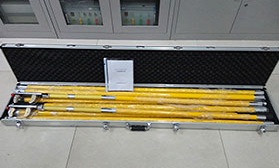
TD1168 High-altitude Test Clamp for Electric Power Maintenance is a special tool for temporary wiring during testing or maintenance of power equipment. It transfers traditional high-altitude operations to the ground, reducing the labor intensity and danger for operators while improving work efficiency, making it an ideal special wiring tool for on-site wiring test personnel.
Main Features:
(1) Simple operation: Use the special operating rod to hook the clamp opening onto the wiring position. By pushing and pulling the special operating rod, the clamp opening can be freely opened and closed to complete the wiring work. The clamp opening has a large size (70mm) and is equipped with a hooking and guiding mechanism, making operation very convenient.
(2) Strong clamping force: The upper and lower clamp jaws utilize the principle of movable pulleys to save effort, thus a smaller pulling force can achieve a larger clamping force.
(3) The clamp is internally equipped with a special clamping force locking and releasing device. When pulling the special operating rod, the spring energy storage device inside the clamp can automatically lock the clamp opening at any required clamping force. When pushing the special operating rod, the releasing device inside the clamp can open the clamped jaws. If the special operating rod is not manually pushed, the self-locking device inside the clamp will never allow the clamped jaws to open by themselves, ensuring safety and reliability.
(4) Good contact: While clamping, it has the function of overcoming oxidation. The DT1168 High-altitude Test Clamp ensures good contact between the clamp jaws and the wiring position.
(5) Strong overload capacity: Short-term current carrying capacity is greater than 100A.
(6) Strong practicality: The angle of the clamp jaws can be changed, allowing it to complete test or maintenance grounding wiring at different angles, thicknesses, diameters, and heights below 8 meters. It is lightweight and easy to use. The structure is reasonably designed, with excellent quality and durability. The weight of the clamp head is less than 700 grams.
Configuration Details of High-altitude Test Clamp |
No. |
Name |
Length (m) |
Current (A) |
Voltage Withstand (KV) |
Material |
Remarks |
1 |
Test Clamp Head |
0.5 |
Above 100A |
|
Stainless steel shell, copper clamp jaws |
Clamp opening 80mm |
2 |
Plug-in Operating Rod |
4m, 3 sections |
|
500 |
Epoxy insulating rod |
*The section connecting to the clamp head and the last section are always fixed in direction; the remaining sections are interchangeable and can be connected arbitrarily. Height is selected according to user requirements. |
3 |
Plug-in Operating Rod |
5m, 4 sections |
|
500 |
Epoxy insulating rod |
4 |
Plug-in Operating Rod |
6m, 5 sections |
|
500 |
Epoxy insulating rod |
5 |
Plug-in Operating Rod |
8m, 6 sections |
|
500 |
Epoxy insulating rod |
6 |
Current Wire |
10mm2*10m A/φ6 thick lug*2 (for test clamp end)
B/φ10 thick lug*2 (for instrument end)
Same color parallel wires, red and black, 1 pair/set
|
Connection wires are generally configured according to user requirements, or may not be provided. |
7 |
Voltage Wire |
1.6mm2*10m A/φ6 thick lug*2 (for test clamp end)
B/φ8 thick lug*2 (for instrument end)
Same color parallel wires, red and black, 1 pair/set |
8 |
Short-circuit Wire |
Short-circuit wire: 10mm2*0.3m A/Bφ6 thick lug, one red and one black |
7 |
Aluminum Alloy Case |
For 6m single unit: 1420*260*140mm
For 6m 2 units: 1420*290*150mm
For 6m 3 units: 1420*345*180mm
For 8m 2 units: 1420*330*160mm |
|
Usage Instructions:
It consists of two parts: the test clamp handle (the short section at the head) and the extended telescopic rod. Connect the test clamp handle to the telescopic rod by screwing them together tightly to form one unit, then pull out each section of the telescopic rod, and position it according to the instructions on the rod and by using the spring-loaded head on the rod to enter the positioning hole. The operator can directly operate from the ground, lifting the installed high-altitude test clamp (including connected test wires, etc.) (length can be customized). Hook the upper jaw onto the object to be tested, pull the operating rod down with force, and the jaws will automatically lock and grip the object. Conversely, push gently to release. This tool is convenient to use and test.