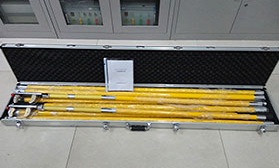
TD-1168 High Voltage Test Clamp Product Advantages:
1. This product can be directly operated from the ground, enabling high-altitude testing at 3~8m, with strong practicality and ease of use.
2. It adopts the principle of mechanical transmission, which is safer and more reliable than the previous method of pulling with steel wire ropes, and is easier to operate, saving time and effort. It will not cause phenomena such as jamming, inability to pull, or breakage that affect on-site operations due to aging of the steel wire rope.
3. The test clamp jaw is made of multi-layer copper sheets welded together. The wider and thicker jaw design allows a large current to pass through in a short time, with advantages such as good contact and strong overload capacity.
4. The current insulating operating rod is now connected by plug-in bolts. To prevent the aluminum alloy joints from seizing, the TD-1168 multi-functional high-altitude test clamp adopts a stainless steel sleeve to make the connection more reliable and safe. After connection, the entire operating rod has better coordination, smaller gaps, and less shaking during testing, making operation safer.
5. This product can be used for high-voltage testing below 500KV, with test heights ranging from 3m to 8m, and can be arbitrarily extended by adding plug-in sections to the insulating operating rod. The withstand voltage test of this insulating operating rod has passed the high-voltage 500KV/AC test at Shanghai Cable Research Institute, and the verification report has been obtained.
Usage Method:
This product consists of a test clamp handle (the short section at the head) and an extended insulating operating rod. Connect the test clamp handle with each section of the operating rod by threading and tightening them to form an integrated unit, and connect each operating rod according to the instructions on the rod. The operator directly operates from the ground, lifting the installed high-altitude test clamp (including connected test leads, etc.) (the length can be customized). Hook the upper jaw onto the object under test, pull the operating rod down with force, and the jaw will automatically lock, clamping the object for testing. Conversely, push it gently to release the test jaw. This tool is convenient to use and test.
Configuration Details:
No.
|
Name
|
Length
(m)
|
Current
(A)
|
Withstand Voltage
(KV)
|
Material
|
Remarks
|
1
|
Test Clamp Head
|
0.5
|
Above 100A
|
|
Stainless steel shell, copper jaw
|
Jaw opening 80mm
|
2
|
Plug-in Operating Rod
|
4m, 3 sections
|
|
500
|
Epoxy insulating rod
|
The 1st section connects to the clamp head, and the 2nd and last sections are always oriented; the other sections are interchangeable and can be plugged in arbitrarily. The height is selected according to user requirements.
|
3
|
Plug-in Operating Rod
|
5m, 4 sections
|
|
500
|
Epoxy insulating rod
|
|
4
|
Plug-in Operating Rod
|
6m, 5 sections
|
|
500
|
Epoxy insulating rod
|
|
5
|
Plug-in Operating Rod
|
8m, 6 sections
|
|
500
|
Epoxy insulating rod
|