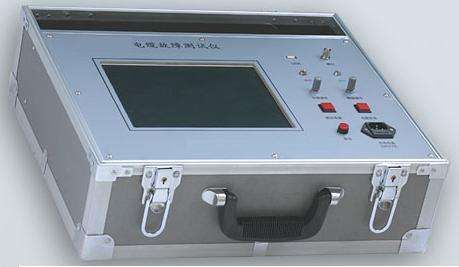
Test objects of the high voltage flashover method for cable fault tester:
The high voltage flashover test method is suitable for testing high resistance faults of cables (high resistance leakage faults and high resistance flashover faults). The vast majority of faults in power cables are high resistance faults. We know that any fault where the DC resistance at the fault point is greater than the characteristic impedance of the cable is called a high resistance fault. High resistance faults are further divided into high resistance leakage faults and high resistance flashover faults, and the high voltage flashover method is divided into DC high voltage flashover method (abbreviated as direct flashover method) and impulse high voltage flashover method (abbreviated as impulse flashover method). The low pulse method cannot test high resistance faults because the equivalent impedance at the fault point is almost equal to the characteristic impedance of the cable, so its reflection coefficient is almost zero, and no reflected wave can be obtained for testing.
Operating steps of the impulse high voltage flashover method (impulse flashover method) for cable fault tester:
The impulse high voltage flashover method is further divided into two types: impulse high voltage voltage flashover method (abbreviated as impulse voltage method) and impulse high voltage current flashover method (abbreviated as impulse current method).
1. Impulse voltage method. The instrument's "work selection" is still set to "high voltage" position. The test process is the same as the direct flashover method, except that the sampling connection method is changed. After pressing the "sampling" key, slowly increase the voltage regulator voltage. When the fault point flashes over and discharges,
To capture the full waveform of the impulse L, it appears as a damped cosine oscillation waveform, indicating that the fault point has discharged.
Press the left and right keys to move the cursor to position t1 (note: not t0; but t1 is the reading starting point), press the "cursor positioning" key, then press the left and right keys to move the active cursor to the inflection point at t2. At this time, the data displayed at the bottom of the screen is the distance from the fault point to the test end.
2. Impulse current method. Impulse current sampling is the main test method. Its advantages are: convenient use, safe waveform, and accurate testing.
Wiring diagram for impulse current sampling method