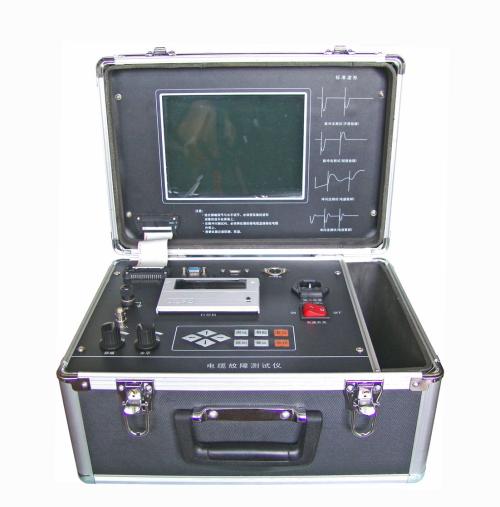
The cable fault tester is an important tool for maintaining various cables. The intelligent cable fault tester utilizes multiple fault detection methods, applies modern advanced electronic technology achievements, uses computers and special electronic technology, combines the successful experience of the company's long-term development of cable testers, and introduces a new generation of high-tech products with intelligence and complete functions.
The cable fault tester adopts modern classic DC high-voltage flashover method, pulse high-voltage inductance sampling method, pulse high-voltage current sampling method, low-voltage pulse method and other testing methods. It is suitable for measuring low-impedance, short-circuit, open-circuit and broken-line faults, high-resistance leakage and high-resistance flashover faults of power cables and high-frequency coaxial cables with various cross-sections, different media and various materials. It can also be used to detect short-circuit, open-circuit and mixed line faults of local telephone cables, and can also calibrate the full length of cables.
Methods for finding cable faults with a cable fault tester:
1. Use traditional high-voltage flashover method and low-voltage pulse method in conjunction with high-voltage equipment.
2. Any high-impedance fault has a simple waveform characteristic similar to a low-voltage pulse short-circuit fault, which is very easy to read.
3. The cable fault tester finds the fault point through the four main parts: the cable fault locating host, the locator, the path meter and the high-voltage signal generator.
As the name implies, the cable fault tester is an important new type of detection tool that uses multiple fault detection methods to check line faults and maintain various cables. It can be said to be an intelligent product, a smart high-tech product. When using the cable fault tester, we must pay attention to some details. Let me introduce them to you.
1. You cannot rely solely on the data obtained by the instrument to make judgments. You also need to consider actual conditions, such as historical faults and the condition of connectors.
2. If suspicious points are found on the appearance of the cable, you should consult the correct records after the installation and laying of the cable is completed.
3. The position of the three-way joint, the direction of the cable path, the state of one cable to another cable or joint in the underground relationship, and the position of the joint where two cables of different cross-sections are connected.