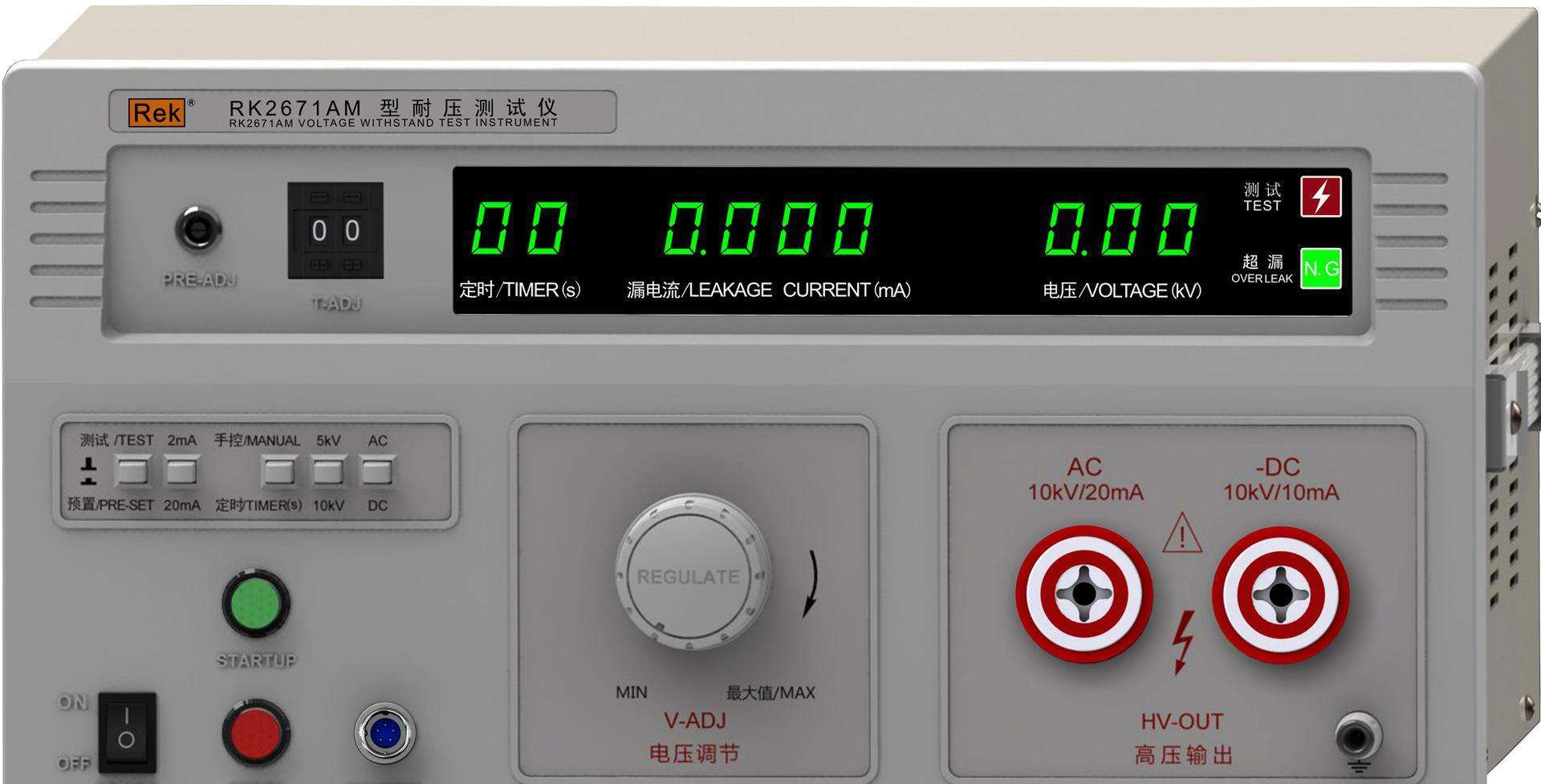

The insulation withstand voltage tester is a voltage testing device designed according to the power industry standards, used to test the insulation strength of various electrical products, electrical components, insulating materials, etc. under specified voltages. It evaluates the insulation level of products, discovers insulation defects in tested products, and measures the ability to withstand overvoltages.
Frequently used on production lines, especially test lines, test fixtures, etc., which are often in an active state, it is easy to cause internal core wire breakage, and it is generally not easy to find. As long as any point in the circuit has an open circuit, the output high voltage of the insulation withstand voltage tester cannot be truly applied to the tested object. These reasons can lead to the situation where during the withstand voltage test, the tested object is not actually subjected to the set high voltage. Of course, at this time, the current flowing through the tested object is almost zero. Since it does not exceed the upper limit set value of the insulation withstand voltage tester, the instrument will give a test qualified indication and consider the insulation qualified, but the test data in this case is not true. If the insulation performance of the tested object has defects at this time, it will cause serious misjudgment.
The insulating oil in power transformers needs to be regularly inspected after long-term use to determine the insulation withstand voltage level of the transformer oil and whether it can be used. Therefore, an oil dielectric strength tester is needed. After the equipment tests the insulating oil, how to judge the test results is particularly important. If the results cannot be judged, then the test is meaningless.
During the test, there are four changes in the discharge resistance of insulating oil:
1. The first spark discharge voltage is extremely low. The first test may have some external factors, because the oil sample is injected into the oil cup or the surface of the oil cup electrode before oil injection, which makes the first test value deviate, lower, at this point, the average can be taken from 2-6 times.
2. The 6 spark discharge voltage values gradually increase, usually appearing in oil samples that have not been thoroughly cleaned or treated and have hygroscopic properties. This is due to the increase in oil humidity after spark discharge.
3. The six spark discharge voltage values gradually decrease, usually appearing in pure oil tests, because free charged particles, bubbles, and carbon debris increase one by one, destroying the insulation performance of the oil. Also, in automatic oil tests, without stirring during six consecutive tests, carbon particles between electrodes gradually increase, causing the spark discharge voltage to decrease.
4. The spark discharge voltage is low at both ends and high in the middle, which is a normal phenomenon. If there is a large deviation in the pressure tolerance value, for example, in tests based on preventive test methods, the value of this one test deviates from other values. It may not be possible to calculate this value, or the oil sample may be retested. This may be due to poor oil quality or uneven distribution of free carbon. Due to the high dispersion of oil withstand voltage test results, if each breakdown voltage is high (close to 80kV) or the results are the same, it indicates that the instrument may be damaged, please contact the manufacturer.