Desktop|中文
Home About Us Products + News Center Technical Articles Messages Contact Us

Product Details

全自动Dielectric Loss Tester-扬州达瑞

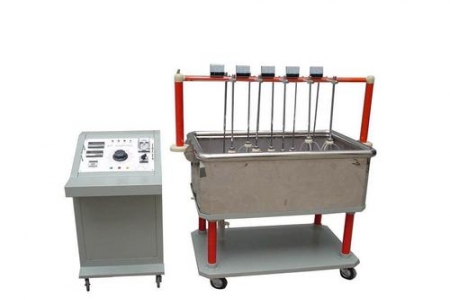
Insulation Boots (Gloves) Withstand Voltage Tester Price

Published: 2020-08-19 10:56:38

Views: 2922

Category: Insulation Boot Withstand Voltage Test Device

Product Description
Insulation Boots (Gloves) Withstand Voltage Tester Price


Darui Electric recommends for you


Main Functional Features


1. According to the new industry standard requirements, the leakage current is assessed as the test basis, which is more scientific.

2. According to the new industry standard requirements, insulation boots should use special electrodes without filling water. Insulation boots that pass the test can be put into use immediately, and the service life of insulation boots is improved.

3. Combined structure, movable, transportable, and easy to prepare.

4. It can complete the withstand voltage test of 5 pairs (10 pieces) of insulation boots or gloves at one time, and accurately detect 10 channels of leakage current simultaneously.

5. Automatic timing.


Main Technical Parameters


1. Special electrode: ф3mm   steel balls

2. Test voltage: AC 0—50Kv   DC 0-60KV 

3. Test current: 0—60mA 

4. Test quantity: 5 pairs/10 pieces   10-channel current detection

5. Current measurement accuracy: Class 0.2

6. Voltage measurement accuracy: Class 0.2 (0.5+1.0) 

7. Current measurement range: AC 0~19.99mA, resolution: 0.01mA

8. Voltage measurement range: AC 0~50.0KV, capacity 1.5KVA

9. Measurement accuracy: error ≤ 2% of reading ± 2 digits

10. Power supply: single-phase 220V power frequency supply

11. Dimensions:

    High-voltage test device: 1400mm (length) × 550mm (width) × 1500mm (height)

    Data processing device: 450mm (length) × 300mm (width) × 200mm (height)

12. Equipment weight: high-voltage test device 55kg, data processing device: 5kg 


Usage Method


It consists of two main parts: the test host and the test bench. After unpacking the two parts, fix the test bench, and connect the ground wires of the host and discharge rod. Connect the control wires between the host and the high-voltage box.

During the test, fill the test object with steel balls (about 1.5-2.0 kg of metal balls per insulation boot), then adjust the electrode rod through the locking screw so that the electrode is inserted into the insulation boot (glove) to the same position as the steel ball surface.

After the above work is completed,

Power frequency withstand voltage test:

Start the test → install the test object → turn on the high-voltage box power → turn on the host power → press Settings → enter the settings screen, set the test voltage, leakage current, and test time. Then enter the test screen, press high voltage on, turn on automatic mode, press start to conduct the test, and automatically reduce voltage after completion.

DC withstand voltage test:

Start the test → remove the transformer short-circuit rod → connect the capacitor high-voltage silicone rubber wire to the electrode → install the test object → turn on the high-voltage box power → turn on the host power → press Settings → enter the settings screen, select DC test, set the test voltage, leakage current, and test time. Then enter the test screen, press high voltage on, turn on automatic mode, press start to conduct the test, automatically reduce voltage after completion, end the test → turn off high voltage → turn off host power → turn off high-voltage box power, then use the discharge rod to fully discharge the electrode, hang the ground wire, remove the high-voltage silicone rubber wire and ground it, and finally remove the test object.

Note: The high-voltage switch can only be closed when the voltage regulator is at zero point. If there is no response after pressing the high-voltage switch, press and hold the voltage reduction switch on the test screen until the voltage regulator returns to zero, then press high voltage on again. At this time, you will hear a "beep" relay closing sound. If the equipment is not used for a long time, the electric voltage regulator should be moved away from the zero position to prevent the zero-position switch spring from losing elasticity due to prolonged stress.


Product Introduction


1.1 Purpose

According to the new State Power Development (2002) No. 777 "Preventive Test Regulations for Power Safety Tools and Equipment", it can quickly complete the power frequency withstand voltage test of commonly used auxiliary insulation tools such as insulation gloves, insulation boots, and insulation rubber pads in a more scientific and reasonable way.

Auxiliary insulation safety tools refer to those whose insulation strength does not withstand the working voltage of equipment or lines, but are only used to strengthen the protective effect of basic insulation safety tools, to prevent contact voltage, step voltage, and leakage current arc from harming operators. They cannot be used to directly contact live parts of high-voltage equipment. Safety tools in this category include: insulation gloves, insulation boots, insulation rubber pads, etc.

This instrument is mainly used to conduct power frequency withstand voltage tests on safety tools such as insulation gloves and insulation boots, to determine whether these tools meet the usage conditions and ensure the personal safety of workers.

1.2 Test Basis

The "Preventive Test Regulations for Power Safety Tools and Equipment" issued by the State Power Corporation and implemented on November 7, 2002.


<
WeChat QR Code
💬
💬 Message

Hello! Have you found what you need? Contact us directly online!

Leave a Message for Consultation
Yangzhou Darui Electric Co., Ltd.
主营产品:Dielectric Loss Tester、Transformer Ratio测试仪、Loop Resistance Tester、高压None线核相仪、Insulation Resistance Tester、Partial Discharge Tester、Cable Fault Tester、DC Resistance Tester等。
☎ Phone: 18952707000(关经理)📞 Landline: 0514-88770377✉ Email: 195214804@qq.com
Verification Code
By submitting, you agree to ourTerms of ServiceandPrivacy Policy
🏠 网站Home📞 一键拨号✉ Contact Us