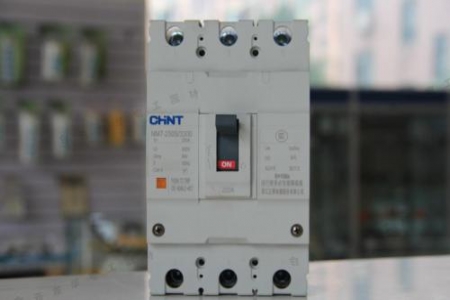
CHINT molded case circuit breakers, also known as device-type circuit breakers, have all their parts sealed inside a plastic housing. Auxiliary contacts, undervoltage releases, and shunt releases are mostly modularized. Due to their compact structure, molded case circuit breakers are generally not repairable. They are mostly
manually operated, with large-capacity units optionally using electric opening and closing. With the application of electronic overcurrent releases, molded case circuit breakers can also be classified into Class A and Class B. Class B has good three-stage protection characteristics, but due to price factors, Class A products with thermal-magnetic releases have a higher market share. Molded case circuit breakers house the contacts, arc extinguishing chamber, release, and operating mechanism all within a plastic shell, generally not intended for maintenance, and are suitable as branch protection switches. Overcurrent releases come in thermal-magnetic and electronic types. Generally, thermal-magnetic CHINT molded case circuit breakers are non-selective circuit breakers, offering only overload long-time delay and short-circuit instantaneous protection. Electronic molded case circuit breakers have four protection functions: overload long-time delay, short-circuit short-time delay, short-circuit instantaneous, and ground fault. Some newly launched electronic molded case circuit breakers also feature zone selective interlocking. Most molded case circuit breakers are manually operated, with some having motor-operated mechanisms.
CHINT Molded Case Circuit BreakerWorking Principle
The main contacts of a low-voltage circuit breaker are closed manually or electrically. After the main contacts close, the free trip mechanism locks them in the closed position. The coil of the overcurrent release and the thermal element of the thermal release are connected in series with the main circuit, while the coil of the undervoltage release is connected in parallel with the power supply.
When a short circuit or severe overload occurs in the circuit, the armature of the overcurrent release is attracted, causing the free trip mechanism to operate and the main contacts to open the main circuit.
When the circuit is overloaded, the thermal element of the thermal release heats up, causing the bimetallic strip to bend and push the free trip mechanism to operate, opening the main contacts.
When the circuit is undervoltage, the armature of the undervoltage release is released, also causing the free trip mechanism to operate and the main contacts to open the main circuit.
When the shunt release button is pressed, the armature of the shunt release is attracted, causing the free trip mechanism to operate and the main contacts to open the main circuit.
CHINT Molded Case Circuit BreakerProduct Parameters
Brand: CHINT
Number of Poles: 3P
Rated Frequency: 50 (Hz)
Rated Insulation Voltage: 690 (V)
Release Current: 16-100 (A)
Product Certification: CCC
Installation Method: Fixed
Speed: Normal Type
Arc Extinguishing Medium: Air Type
Structure: Molded Case Type
Operation Mode: Electric Operation
Note: The above information and technical parameters are compiled and published by Yangzhou Dary Electric Co., Ltd.