Technical Parameters
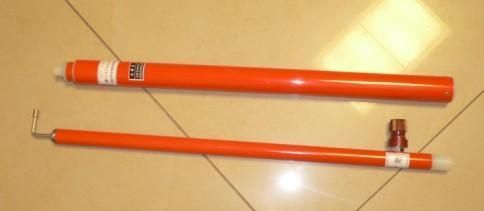
1. Discharge rod retracted dimensions: length 220mm, outer diameter φ34.
2. Number of retracted sections: 5.
3. Discharge rod extended dimensions: extended length 850mm.
4. Discharge voltage range: 5kV~220kV.
Product Features
The DC high-voltage discharge rod is essential equipment to ensure the personal safety of every test personnel. It has the characteristics of being extendable and retractable. As an indispensable instrument in safety tools, what product features does it have? The analysis is as follows:
1. Negative output, zero start, continuously adjustable, with various protection functions such as overvoltage, overcurrent, zero return, grounding protection, and broken wire protection. Strong automatic protection, safe operation, and all technical indicators are superior to industry standards and similar products.
2. The DC high-voltage discharge rod is small in size, light in weight, more beautiful, more reliable, easy to operate, and fully functional. It is an ideal replacement product for the new century.
3. The voltmeter on the DC control box directly displays the voltage value applied to the load test object. No external voltage divider or current limiting resistor is needed during use, making wiring simple and operation convenient.
4. It has a 75% function, bringing great convenience to zinc oxide arrester measurements. The control box of this instrument has a 75% voltage switch function key. When the current rises to 1000uA, press the 75% button. At this time, the values displayed on the voltmeter and ammeter are the 75% data. After completion, immediately return the boost knob to zero, and also return the fine-tuning voltage knob to zero. Then immediately switch the 75% button back to the normal position before conducting other tests.
5. High DC precision and accurate measurement. The output voltage adjustment uses a single multi-turn potentiometer, with a smooth boosting process, high adjustment precision, and coarse and fine adjustment functions. The instrument has high and low voltage end leakage current measurement. The high voltage end uses a spherical shielded digital display, which is not afraid of discharge impact, has good anti-interference performance, and is suitable for field use.
6. The DC adopts advanced technology and manufacturing processes, pulse train logic array modulation, high-power IGBT devices, and phase fuzzy control, resulting in higher output stability and smaller ripple coefficient.
Precautions
1. When discharging large capacitance test objects, after the test is completed and the test power supply is disconnected, wait for a period of time to allow the charge on the test object to self-discharge to the ground through the voltage doubling cylinder and the test object itself. At this time, observe that the voltage on the voltmeter of the control box gradually drops. When the voltage drops to a lower voltage, generally around 5kV to 15kV, you can use the discharge rod to gradually move near the test object. First, discharge through the gap air ionization, and you can hear a hissing sound. When there is no sound, touch the test object with the tip of the discharge rod, and finally directly ground the test object for discharge.
2. The amount of accumulated charge on a large capacitance test object is proportional to the capacitance of the test object and the magnitude and duration of the applied voltage.
3. After testing high-voltage cables of several kilometers or more, the discharge time is generally very long and requires multiple repeated discharges. The resistance capacity needs to be large, so a large-capacity discharge rod should be ordered.
4. It is strictly forbidden to use the discharge rod to discharge the test object without disconnecting the test power supply.
5. It is strictly forbidden to step on or squeeze the discharge rod with heavy objects, and it is strictly forbidden to bend or break the discharge rod.
6. It is strictly forbidden to expose the discharge rod to moisture, as it affects the insulation strength. It should be stored in a dry place.

.jpg)