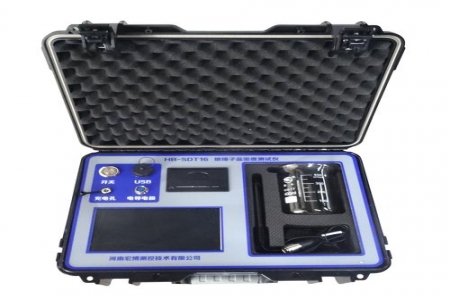
4. The instrument adopts a 2.8-inch true color LCD screen.
5. Directly displays salt density, pollution level, and unified specific creepage distance.
6. Automatic temperature compensation, directly displays standard conductivity and equivalent salt deposit density (ESDD) at 20℃.
7. Has the function of automatically removing the salt content of the original solution, reducing the requirements for cleaning solution.
8. Automatically converts the salt density (ESDD) measured without power to the salt density (ESDD) measured with power.
9. Can store 100,000 sets of records, and can save records to SD card for reading on computer.
10. Can view and delete single records, or delete all records.
11. Built-in large capacity rechargeable lithium battery (2600mAh), suitable for field use.
Technical Parameters
1. Measurement range:
Salt density: 0.0001mg/cm2~9.9999mg/cm2 (based on X-4.5 insulator)
Temperature measurement: 0℃~100℃
Conductivity measurement: 0~200000μs/cm
2. Basic error:
Salt density measurement: resolution 0.0001mg/cm2
Full scale accuracy: ±2%
Temperature measurement: resolution 0.1℃, accuracy ±0.5℃
Conductivity measurement: resolution 0.01μs/cm
3. Power supply: built-in rechargeable lithium battery
4. Ambient temperature: 0℃~60℃
Ambient humidity: <90%
Equipment Introduction
TPYMC-B handheld insulator salt density tester is developed for anti-pollution flashover detection in power systems. It is a special measuring instrument for measuring the equivalent salt deposit density on the surface of insulators, and can also measure the conductivity and temperature of the solution. It has the characteristics of high measurement accuracy, wide measurement range, and convenient use, and is widely used in electric power, teaching, scientific research, and other industries.
The division of pollution levels and the drawing of pollution level distribution maps are the basis of anti-pollution flashover work. An accurate pollution level distribution map is the basis for selecting the creepage distance of external insulation of porcelain insulators for transmission and transformation equipment. The equivalent salt deposit density value on the surface of insulators is quantitative data for judging the severity of external insulation pollution of porcelain insulators, and is one of the important bases for dividing pollution levels and drawing pollution area maps. Therefore, salt density measurement work is of great significance to the safe operation of the power system.
Note: The above information and technical parameters are compiled and released by Yangzhou Dari Electric Co., Ltd.