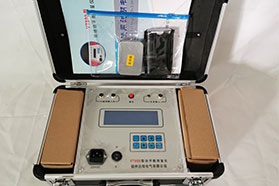
Centrifuge Dynamic Balancing Measuring Instrument Technical Parameters
1. General Measurement:
Speed Measurement: 30~30,000 rpm
Vibration Measurement: 0.01~5000μm (Peak-to-Peak)
0.01~2000mm/s (RMS)
Vibration Analysis: FFT Spectrum Analysis
Display: Dot Matrix Graphic 64X240 Dot Matrix LCD with Chinese Menu
Key pad: Eight Keys
2. Dynamic Balancing Measurement:
Measurement Points: Single Point or Single Plane Dual Points or Dual Planes
Vibration Signal Frequency Band: 3Hz~1KHz
Same-Frequency Operating Speed: 180~30,000 rpm
Same-Frequency Amplitude Range: 0.01~5000μm (Peak-to-Peak)
Vibration Severity Range: 0.01~2000mm/s (RMS)
Phase Accuracy: 0-360°±1 °
Unbalance Reduction Rate: ≥95%
Centrifuge Dynamic Balancing Measuring Instrument Principle
The centrifuge drum is a long roller-shaped rotor, requiring two correction planes for balancing to reduce the rotor unbalance and the fundamental frequency vibration of two bearings to a level within the allowable range. The balance quality grade is G6.3, the rotor mass is 176kg, and the balancing speed is 1500/min. The two end faces 1 and 2 of the rotating rotor are used as correction planes, with correction radii R1=140mm for plane 2 and R2=140mm for plane 2. Bearings A and B are used as measurement planes to measure the horizontal vibration of the bearings. A photoelectric sensor monitors the reflective strip of the reference mark on the pulley end face to provide speed and phase reference signals.
The centrifuge operates at the working speed, measures the initial unbalance vibration of the two bearings, and stores and records the data. The measurement results are as follows:
Initial Operation
Speed: 1500r/min
A 9.52mm/s rms ∠11º
B 8.10mm/s rms ∠310º
Note: The measurement parameter is vibration velocity, and rms indicates the root mean square value of vibration velocity.