Principle of Dynamic Balancing Measuring Instrument
1. General Measurement:
Speed Measurement: 30~30,000 rpm
Vibration Measurement: 0.01~5000μm (Peak-to-Peak)
0.01~2000mm/s (RMS)
Vibration Analysis: FFT Spectrum Analysis
Display: Dot Matrix Graphic 64X240 Dot Matrix LCD with Chinese Menu
Keyboard: Eight Keys
2. Dynamic Balancing Measurement:
Measurement Points: Single Point or Single Plane Dual Points or Dual Planes
Vibration Signal Frequency Band: 3Hz~1KHz
Same-Frequency Operating Speed: 180~30,000 rpm
Same-Frequency Amplitude Range: 0.01~5000μm (Peak-to-Peak)
Vibration Severity Range: 0.01~2000mm/s (RMS)
Phase Accuracy: 0-360°±1 °
Unbalance Reduction Rate: ≥95%
Principle of Dynamic Balancing Measuring Instrument
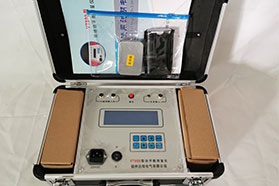
Panel Schematic Diagram:
Photoelectric Input – Connect to photoelectric sensor.
Vibration Input – Connect to A and B magnetoelectric speed sensors (or eddy current sensors as per user requirements).
The photoelectric indicator flashes synchronously with the equipment speed.
The charging indicator is red during battery charging and turns green when fully charged.
Please note that when the battery voltage drops below 10V, timely charging is required.
AC-DC switch set to AC side, powered by AC220V. With the power switch off, the battery is charged. When the switch is set to DC side, the internal battery supplies power.
Main Functions of Chinese Version Digital Display Dynamic Balancing Instrument
●Multifunctional: can be used as a tachometer, vibration measurement instrument, and especially has all functions for dynamic balancing measurement. (Real-time display of unbalance vibration and phase)
●Automatically uses the trial weight method to measure influence coefficients and calculate single-plane and dual-plane optimal counterweights, or directly calculates optimal counterweights based on measured original vibration when influence coefficients are known. Can calculate while measuring or input all at once.
●Has the ability to calculate the optimal counterweight at selected angles to the left or right.
��Has frequency analysis capability to detect vibration components at same frequency, half frequency, and multiples of the rotor speed.
●Simple operation with automatic prompts, usable by general personnel.
Operating Precautions
1. During continuous measurement, do not press the "Reset" key easily, as it will lose all data entered. If you have the influence coefficients at hand, you can re-enter them.
2. Ensure the photoelectric marker is properly applied and observe the accuracy of the machine speed. This is crucial for the instrument to perform dynamic balancing tests.
3. Machine vibration can be caused by many factors. Only when the same-frequency amplitude constitutes a large portion of the total vibration amplitude can dynamic balancing effectively reduce vibration. Otherwise, ideal results cannot be achieved.
4. In the trial weight method, the known trial weight must be added to a known position on the measured plane. Pay attention to the changes in vibration amplitude and phase after adding the weight compared to the original. If the data changes are not significant, the vibration reduction effect after calculation will also be insignificant. If the amplitude change is not obvious, increase the trial weight. If the phase change is not obvious, reposition the trial weight.
5. For the first balancing of a rotor, the trial weight method must be used. After obtaining the influence coefficients through the trial weight method, the influence coefficient method can be used for balancing similar rotors, which is simpler.
6. This instrument can be powered by AC 220V or the internal 12V battery. It is generally recommended to charge with AC 220V and operate with the 12V battery to reduce internal noise. Please note that when the battery voltage drops below 10V, timely charging is required, otherwise the battery life will be affected.
7. The magnetic base of the sensor has strong suction and can easily pinch fingers; please be very careful.
|
|