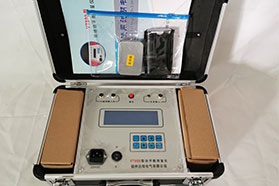
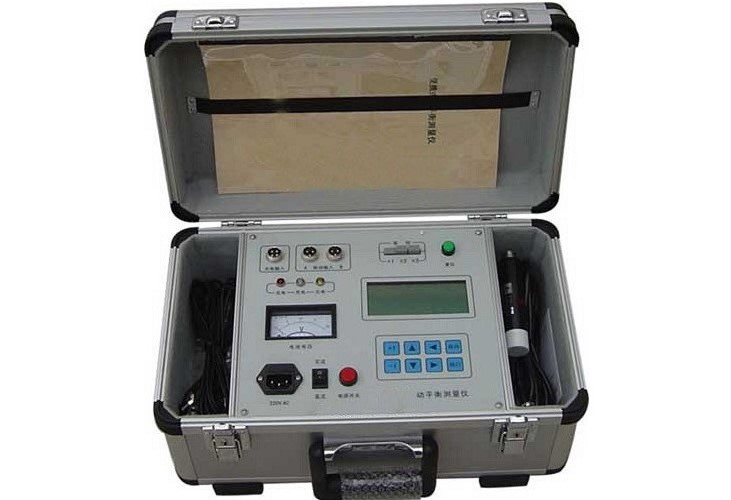
Portable Field Dynamic Balancing Measuring Instrument Product Description
Targeting the highest technology at home and abroad, it adopts large-scale integrated circuits and single-chip microcomputer technology. This instrument is multifunctional, serving as both a tachometer and a vibration tester, especially with all functions for dynamic balancing measurement. It features simple operation, human-machine dialogue, menu prompts, and measurement data can be locked and held at any time. Equipped with both internal battery and mains power supply, it is very convenient for on-site dynamic balancing testing of rotating machinery. It can also be used with balancing machines, directly replacing the balancing machine's electrical box for retrofitting old balancing machines.
Technical Specifications
1. Speed measurement range: 400-30000 rpm
2. Vibration measurement range: 0—3000 μm peak-to-peak
3. One-time unbalance reduction rate >80%
4. Phase tracking accuracy: within 0—360°, less than ±1°
5. Display: Four-line large-character LCD simultaneously displays multiple parameters of two measuring points
Functions:
■ Comprehensive application functions
It can perform single-plane and dual-plane unbalance correction, and provides practical functions such as single and dual-channel vibration analysis, rapid dynamic balancing data acquisition, vector decomposition and composition calculation, ISO permissible unbalance query, and manual input for simulated dynamic balancing.
■ Excellent instrument performance
● Microsoft WindowsCE operating system, stable and efficient;
● High-performance embedded microprocessor with 400MHz main frequency, possessing powerful data processing capabilities;
● High-density FPGA chip provides data acquisition control;
● Low-noise circuit board manufacturing process and hardware gain up to 1024 times, enabling vibration signal resolution up to 0.001um, with balancing accuracy superior to national standards;
● Data storage capacity up to 1G, capable of storing 10,000 sets of on-site balancing process records;
● Low-power hardware design, intelligent power management, and large-capacity lithium battery pack enable KMBALancer to work continuously for more than 7 hours after a single charge.
Main Functions
● Portable Field Dynamic Balancing Measuring Instrument is multifunctional, serving as both a tachometer and a vibration measurement device, especially with all functions for dynamic balancing measurement. (Unbalance vibration amount and phase displayed in real-time)
● It has the ability to automatically use the trial weight method to measure influence coefficients and calculate single-plane and dual-plane optimal counterweights, or directly calculate optimal counterweights based on measured original vibration when influence coefficients are known. It can calculate while measuring or input all at once.
● It has the ability to calculate the optimal counterweight shifted to left or right by a selected angle.
● It has frequency analysis capability to detect synchronous, half-frequency, and multiple-frequency vibration components relative to the rotor.
● Simple operation with automatic prompts, usable by general personnel
Operating Precautions:
1. During continuous measurement, do not press the "Reset" key easily, otherwise all data will be lost. If you have the influence coefficients at hand, you can re-enter them.
2. Be sure to carefully set the photoelectric marker and observe the accuracy of the machine's speed. This is an important guarantee for the instrument to carry out dynamic balancing tests.
3. The causes of large machine vibration are multifaceted. Only when the synchronous amplitude accounts for a large proportion of the total vibration amplitude can the dynamic balancing method reduce vibration. Otherwise, ideal results cannot be achieved.
4. In the dynamic balancing trial weight method, it is necessary to add the known trial weight to the known position on the measured surface. Pay attention to the changes in vibration amplitude and phase after adding the weight compared to the original vibration amplitude and phase. If the data changes are not obvious, the vibration reduction effect after calculation and processing will also be insignificant. If the amplitude change is not obvious, increase the trial weight. If the phase change is not obvious, reposition the trial weight.
5. For the first time balancing a rotor, the trial weight method must be used. After obtaining the influence coefficients through the trial weight method, the influence coefficient method can be used for balancing similar rotors, which is simpler to operate.
6. This instrument can be powered by AC 220V or by the internal 12V battery. Generally, it is recommended to charge with AC 220V and power with the 12V battery to reduce internal noise. Please note that when the battery voltage drops below 10V, it should be charged promptly; otherwise, the battery's lifespan will be affected.
7. The magnetic base of the sensor has strong suction and can easily pinch fingers; please be very careful