Introduction:
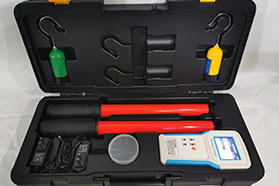
WHX-300C Digital High Voltage Phase Detector (10V~550kV voltage full-automatic phase detection) Ø Phase detection, voltage detection, phase, frequency, phase sequence testing Ø Fully intelligent, wireless transmission, voice phase detection Ø 10V~550kV voltage full-automatic phase detection Ø 10V low voltage phase detection Ø Wireless transmission distance 100m Ø -20°~20° same phase; 100°~140°, 220°~260° different phase Ø Self-calibration error ≤±3°; on-site same phase error ≤±7°, different phase error ≤±12° Ø Phase resolution 1° Ø Insulating rod contracted state is 600mm; extended state is 3200mm; withstand voltage ≤110kV Ø 4.3-inch 65K color screen display Ø "Same phase, different phase" and other voice functions Ø USB interface, 200 sets of data storage, software monitoring, data upload to computer
Product Features:
Before new power stations are connected to the grid, before new substations are put into operation, after expansion, renovation, or major maintenance of power transmission and transformation projects, WHX-300C Digital High Voltage Phase Detector is often used for phase verification tests at the completion and commissioning site, i.e., the so-called phasing, which includes checking the phase sequence and phase, that is, measuring the phase difference and corresponding phase sequence of the corresponding phases of the two grids to be connected.
When using wired phase detection, four people are required: one acts as the commander, two wear insulating boots and insulating gloves as phase detectors, and one records the instrument readings. The phase detection work is carried out according to the commander's orders. The high-voltage operator fixes the high-voltage lead wire on the insulating rod at an appropriate length, and when using the insulating rod to bring the high-voltage wire into contact with the high-voltage power point, the movements must be coordinated, and the two people must look after each other to avoid mistakes and dangers. The wired method requires long trailing wires, which is very inconvenient to use.
The lead wires connecting the two ends of the open circuit point have been removed, and communication is achieved through radio signals, which can also penetrate walls and partitions, allowing one person to operate the instrument easily and safely.
Technical Parameters:
Transmission distance limited to within 20 meters;
The transmitting/receiving device is powered by a 9-12V battery;
LCD displays the phase value and determines the phase sequence relationship;
The transmitting device can also be used as a voltage detector;
Weight: transmitting device 0.4KG, receiving device 0.3KG;
Transmitting device probe: hook type, length 10cm x opening 6cm
Receiving device probe: I type, length 10cm