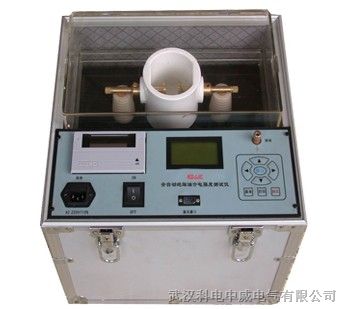
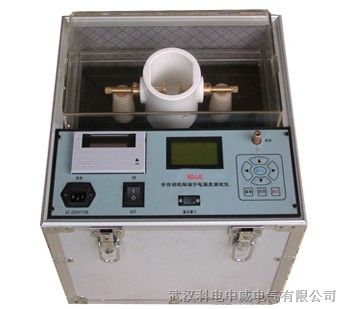
makeboluo Insulating Oil Dielectric Strength Tester, Automatic Insulating Oil Dielectric Strength Testermakeboluo Insulating Oil Dielectric Strength Tester, Automatic Insulating Oil Dielectric Strength Testermakeboluo Insulating Oil Dielectric Strength Tester, Automatic Insulating Oil Dielectric Strength Testermakeboluo Insulating Oil Dielectric Strength Tester, Automatic Insulating Oil Dielectric Strength Tester
【Product Introduction】
KDJJC Insulating Oil Dielectric Strength Tester is used for measuring the dielectric strength of insulating oil in power systems, oil fields, factories, and scientific research institutions. It uses a microcontroller as the main
controller, adopting the method of setting first and then starting the test. The entire process is automatically controlled by the microcomputer, featuring high detection accuracy, simple operation, compact size, intuitive readings, and
light weight. This instrument has automatic detection functions, such as automatically entering the reset state to execute voltage regulator return, and automatic printing output.
【Product Features】
This instrument is suitable for testing the dielectric strength of various insulating oils. Its main performance features:
1. The instrument has automatic detection functions, such as automatically entering the reset state to execute voltage regulator return upon startup.
2. It uses a micro TPU-A panel printer for automatic printing output.
3. According to user requirements, it can change the number of tests, stirring time, settling time, and sound/light controlled reminders with continuous printing.
4. The instrument uses fully automatic magnetic stirrer stirring to eliminate unevenness and bubbles in the oil sample.
【Product Technical Parameters】
1. Working power: AC 220V ±10%, 50HZ ±5%
2. Measurement range: AC 0-80KV
3. Limited current: 5mA
4. Measurement accuracy: 1.5%
5. Voltage regulation speed: 2.5KV/S±10%
6. Preset settings: times 1-9
Stirring time 0-1 minute 39 seconds
Settling time 0-10 minutes 39 seconds
7. Usage conditions: ambient temperature 5℃-35℃
Relative humidity ≤75%
8. Oil cup gap: 2.5mm (diameter of oil cup feeler gauge)
9. Volume: 415×315×315mm3
10. Weight: 28kg
【Product Precautions】
1. Since this instrument is a special testing device for insulating oil dielectric strength, it should not be used for other purposes. Non-professional maintenance personnel should not open the case arbitrarily.
2. During use, the ground wire and the chassis should be properly grounded.
3. During the voltage boosting process, do not touch the instrument casually to avoid high voltage danger.
4. The oil cup of this instrument should not be arbitrarily subjected to high-temperature drying treatment.
【Product Usage Method】
(1) Preparation
1. Use single-phase AC 220V power supply, and the shell grounding terminal must be connected to a standard ground wire.
2. Carefully inspect the oil cup, paying attention to the axis of the two electrodes. Adjust the electrode gap to: small flat plate: 1.25mm, others are 2.5mm.
3. Turn on the power program switch, the power indicator lights up, and the voltmeter displays 00.0, indicating that the machine is working normally. (A few digits of error in the display is normal
and does not affect test accuracy).
4. Before boosting, the voltage must be reduced first, then the boosting test can be performed, otherwise the action will be refused.
(2) Test
1. Slowly inject the prepared oil sample into the oil cup, rinse twice, then fill the oil cup with the oil sample, place the oil cup on the electrode holder, close the oil cup cover, and press the interlock switch.
(If the oil cup cover is not closed, the action will be refused).
2. Let it stand for 10-15 minutes to remove air bubbles.
3. Press the boost switch to automatically increase the voltage. When the oil breaks down, the overcurrent protection relay and protection system device act, cutting off the power supply to the booster within 0.02 seconds, and the digital display shows the breakdown voltage value of the oil.
4. Press the buck switch, the voltage regulator automatically returns to zero, and after five minutes, the second test can be performed.
5. During the test, if the external voltage is insufficient, although the digital display has not reached 60KV, the voltage regulator turntable has already touched the limit switch.
6. During the test, if abnormal conditions occur, press the stop switch to forcibly cut off the high-voltage power supply (when testing again, reset the stop switch).
【Product Working Principle】
The insulating oil dielectric strength tester is an automated testing device composed of microprocessors, large-scale integrated circuits, and other advanced technologies. The operation process is fully automated
and can print the test data of the oil sample through the micro printer configured on the panel. Compared with ordinary instruments and similar types of instruments, this device has good test stability,
high precision, and good operability. This device has multiple test operation modes in oil testing, with main features:
1. Fully automatic test mode: 6 consecutive tests, automatically calculate the average value, and print the 6 test data and the average through the panel printer.
2. Single automatic test mode: automatically complete 1 test and print the single test data.
It uses an AC reversible motor to drive the voltage regulator at a uniform speed of 3 kV/second, and the voltage is boosted through the step-up transformer. When the oil sample is broken down, the protection system automatically cuts off the boosting power supply
circuit, and at the same time, the protection circuit provides an interrupt signal to the system. After the system responds, it executes the oil breakdown procedure. The main operation contents are:
1. The four-digit LED display flashes 8 consecutive times to indicate oil breakdown;
2. Record the test data;
3. Program-controlled automatic return operation. After returning, according to the number of tests, it determines whether to proceed to the next test operation cycle or automatically exit the test state.
Wuhan Kedian Zhongwei Electric Co., Ltd. is a large enterprise committed to the research and development and manufacturing of electrical equipment. The company specializes in manufacturing variousinsulating oil dielectric
strength testers, automatic insulating oil dielectric strength testers.