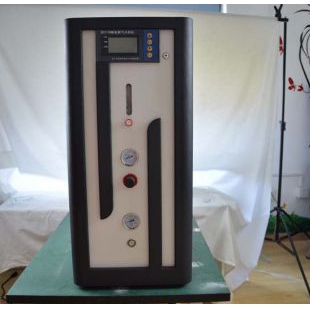
I. Main Features:
1. Korean imported membrane separation, high purity, long service life, no consumable replacement
2. Built-in professional water separator to ensure long service life of adsorbent
3. Three-stage independent filtration system, particles <0.01um & 0.003mg/m³, ensuring continuous gas production
4. Nitrogen purity display, allowing clear observation of the purity of nitrogen produced, high precision
5. Built-in compressor, no external configuration needed, and adopts suspended sound insulation system, low noise
6. Dual pressure value adjustable system, simple and convenient operation
In the chemical industry, nitrogen is mainly used as protective gas, purge gas, displacement gas, and safety gas. It is used as protective gas for aluminum profiles, aluminum products processing, and aluminum foil rolling. It is used as protective gas for reflow soldering and wave soldering to improve welding quality. It is used as protective gas in float glass production to prevent oxidation of the tin bath.
Liquid nitrogen can also be used as a refrigerant for spot removal, and high-purity nitrogen is used as carrier gas for instruments such as chromatographs. It is used as protective gas for bright annealing of copper tubes. It is used together with high-purity carbon dioxide and high-purity helium as gas for laser cutting machines. Nitrogen can also be used as protective gas for food preservation.
The nitrogen generator uses crude nitrogen produced by pressure swing adsorption as raw material, and after adding nitrogen catalytic deoxygenation, condensate adsorption, two-stage drying and dust removal, it removes impurities such as oxygen, water vapor, and dust from nitrogen, thereby obtaining high-purity nitrogen. The purity of crude nitrogen is required to be ≥98%, and the purity of refined nitrogen at the outlet is ≥99.999%, with oxygen content ≤3μm and dew point ≤-65℃.
Regular maintenance of nitrogen generator
1. The drying tube in the nitrogen generator should be replaced regularly. When 50% of the color-changing silica gel in the drying tube changes color, the internal filler should be replaced. Replacement method: Turn off the power and vent the system gas (pressure drops to zero). Unscrew the purification tube in the direction indicated by the arrow, then unscrew the end cap of the purification tube and replace the silica gel desiccant.
2. Treatment method for nitrogen generator materials: Bake the color-changing silica gel in an oven at 120℃ for 12 hours. Calcine the molecular sieve in a muffle furnace at 250℃-300℃ for 24 hours.
3. When replacing the desiccant, care should be taken to place absorbent cotton into the tube, which does not affect the sealing end face, so that the end cap can be tightened to seal.
4. When installing the nitrogen generator, tighten it in the direction indicated by the arrow, and after starting, use soap solution to check for leaks and seal.
5. It is not allowed to wrap various sealing tapes on the threaded surface of the drying tube of the high-flow nitrogen generator inert gas purification device AYAN-20L without authorization, otherwise it will cause the drying tube to crack and fail to seal.
6. The nitrogen generator consumes electrolyte during operation. Distilled water should be added regularly according to usage, and the liquid level should be between the upper and lower limit marks.
7. The nitrogen generator does not consume KOH during operation, but it is recommended to replace the electrolyte every six months. When replacing the electrolyte, first extract the waste alkali solution from the nitrogen generator, add distilled water, start the instrument, let the system clean the electrolysis system for about 5-10 minutes, extract the distilled water, and add the prepared new electrolyte alkali solution.
8. The flow display value of the nitrogen generator is converted from the current loaded on the electrolytic cell. It may have slight changes when subjected to vibration. A display value change within ±10 is normal, but the flow supply can still be output stably.
Below, the editor will introduce the working steps of the nitrogen generator in detail:
1. Deoxygenation: Crude nitrogen is mixed with added hydrogen and enters the deoxygenator. Under the action of a catalyst, impurity oxygen in the crude nitrogen reacts with hydrogen to generate water vapor. The temperature of the deoxygenator is controlled at 80-100℃, so that the water vapor generated by the reaction can be completely carried away by the gas flow, ensuring that the catalyst is not poisoned by water vapor and can be used for a long time without regeneration treatment.
2. Condensation and dust removal: Nitrogen and water vapor first pass through a water cooler to cool to room temperature, then enter a dryer to further cool below the dew point, and then enter a steam-water separator to remove condensed water from the gas.