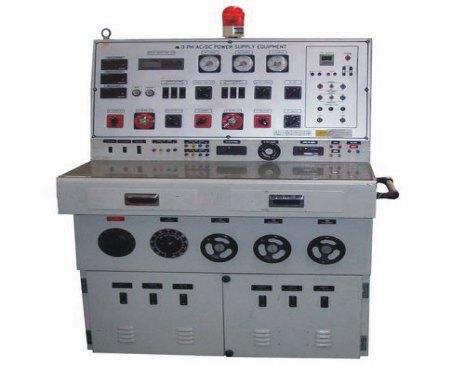
HSXM-380S AC Motor Comprehensive Test Bench
1, Detailed Introduction
Product Introduction:
The development of science and technology has put forward higher and higher requirements for motor performance and quality indicators. The development of motor testing technology is closely related to the development of the motor industry. Motor testing is an important link for comprehensive evaluation of motor assembly quality and technical performance, and is an important process in motor manufacturing and production. Traditional test equipment and methods, due to long operation time, many instruments to observe, manual reading of test data and data analysis and calculation, to a certain extent affect the quality and accuracy of motor testing. With the further improvement of motor design level, process level, and the continuous improvement of motor raw material performance, the performance and quality indicators of motors have been greatly improved. Therefore, the requirements for motor testing technology are also increasing day by day.
In recent years, with the progress of science and technology, it is imperative to improve the efficiency of motor testing, reduce the labor intensity of operators, improve test accuracy and test quality. Due to the enrichment of test theories, the progress of test methods, the improvement of equipment accuracy, and the wide application of automated test systems and computers in testing, motor testing technology has indeed developed by leaps and bounds.
Motor testing is the inspection of technical indicators such as electrical performance, mechanical performance, safety performance, and reliability of semi-finished and finished products in the motor manufacturing process, or supporting products with motors as the main body, using instruments, meters, and related equipment according to relevant regulations. Through these inspections, the relevant performance data of the tested motor can be fully or partially reflected. With these data, it can be judged whether the tested motor meets the design requirements, the quality is good or bad, and the goals and directions for improvement. Motor testing and inspection is an indispensable and important link in motor research, production, and maintenance. Therefore, for units engaged in motor research, production, or maintenance, it is very necessary to have a set of motor testing and inspection equipment that meets the requirements.
Advanced virtual instrument technology is adopted, combining the powerful computing capabilities of computers with the hardware measurement and control capabilities of instruments and equipment. Through software, test control and data calculation, analysis, processing, display, printing, and storage are realized, making the system function far exceed the simple combination of general instruments. Especially in terms of result saving, waveform storage, synchronous measurement, test report generation, system expansion, and multi-function, the advantages are incomparable to traditional manual test benches.
The entire system is fully automated, fully computerized, and highly efficient, with anti-misoperation safety function design. WINDOWS Chinese interface operation, automatic collection of measurement data, automatic calculation of results, automatic generation of factory test reports and print output. The measurement and control system adopts PLC programming control, especially suitable for occasions with high product requirements and batch testing.
2, Product Aliases:
Motor test bench, motor test system, motor comprehensive test bench, motor comprehensive test system, AC motor comprehensive test bench, DC motor comprehensive test bench.
3, Product Features:
◆ Basic composition of the test system
The test system consists of test power supply, power switch cabinet, signal sensing device and power measurement equipment, automated test measurement unit and control console, AC motor test software system, database system, etc. The load equipment in the type test can be selected according to user requirements, including companion motors (DC generator, AC generator, wound rotor motor), eddy current dynamometer, magnetic powder dynamometer, magnetic powder brake, etc., to meet the type test needs of different motors.
◆ Measurement method: using microcomputer measurement
The measurement cabinet is equipped with current and voltage sensors, and the intermediate link adopts signal conditioning interface modules. The computer completes signal acquisition and measurement tasks.
◆ Control method: using automotive-grade MCU direct control
The automotive-grade microcontroller of Siemens, Germany, is used for interlock control. The interlock program can be customized and modified according to user requirements. The control system has stable performance and good system scalability.
◆ Operation method: manual operation and automatic operation coexist
In order to avoid affecting the test work when the computer fails, manual control (panel button operation) and automatic control (computer keyboard/mouse operation) coexist. If automatic control is inconvenient or the computer fails, manual operation can be used for testing.
◆ Test data processing: test results are saved in the industrial computer or server
The computer test bench is equipped with original industrial computers of well-known domestic and foreign brands. The result data of automatic tests is directly saved in the hard disk of the test industrial computer. Manually measured data can be manually entered into the test software interface and then saved in the memory. It provides local database function, can perform local query and access of test data, and has the function of automatic generation of test reports and output printing (configured with HP multifunction laser printer).
◆ High measurement accuracy and good repeatability;
◆ The control system has stable performance and good system scalability.
4, Product Parameters:
◆ Design principles
Based on the design principles of reliability, safety, economy, practicality, operability, and maintainability, while also taking into account advanced nature.
◆ Scope of application
Meet the factory and maintenance tests of three-phase asynchronous motors with rated voltage 380V, 660V, 1140V, 3300V, 6000V, 10000V; rated power 1 ~ 15000kW.
◆ Operating conditions
◇The rated working temperature of the central control room is +20℃, the allowable change range is 0℃~45℃, and the relative humidity of the air does not exceed 85%;
◇The central control room is far away from electromagnetic field interference and mechanical vibration, avoiding the erosion of corrosive gases;
◇The ambient temperature of the screen cabinet area and equipment area is -5℃~+45℃, the relative humidity of the air does not exceed 80% at +40℃, and does not exceed 85% at +25℃;
◇The air shall not contain excessive dust, acid, salt, corrosive and explosive gases;
◇The installation altitude shall not exceed 1000m.
◆ Test items
Users can choose the following test items according to their own requirements:
◇Ambient temperature measurement;
◇Insulation resistance measurement;
◇DC resistance measurement (calculate three-phase resistance unbalance);
◇Power frequency withstand voltage test;
◇Turn-to-turn withstand voltage test;
◇No-load test (calculate three-phase current unbalance);
◇Locked rotor test;
◇Load test;
◇Efficiency test;
◇Temperature rise test.
The system completes the measurement and calculation of voltage measurement, current measurement, power factor measurement, active power measurement, reactive power measurement, efficiency measurement, frequency measurement, output torque, output speed, output power, temperature rise, etc.
◆ Main technical parameters:
◇No-load, locked rotor, load test, temperature rise:
Current measurement accuracy: 0.2%FS±3d;
Voltage measurement accuracy: 0.2%FS±3d;
Power measurement accuracy: 0.5%FS±3d;
Current unbalance calculation: 0.1%FS±3d;
Temperature measurement accuracy: 0.5%±2d;
Speed measurement accuracy: 0.2%FS±3d;
Torque measurement accuracy: 0.2%FS±3d;
◇Power frequency withstand voltage test:
High voltage: 0~100000V adjustable;
High voltage current: 0~3000mA;
Withstand voltage time: 0~9999S;
◇Turn-to-turn impulse withstand voltage test:
Voltage peak: < 30000V, adjustable;
Wavefront time: < 0.5us, adjustable;
◇Insulation resistance measurement
Measurement range: < 200GΩ;
Measurement accuracy: 5%FS±5d;
◇DC resistance measurement:
Measurement current: < 10A;
Measurement resistance: 0~20kΩ;
Minimum resolution: 1uΩ;
Resistance unbalance calculation: 0.1%FS±3d;
Measurement accuracy: 0.2%FS±3d.