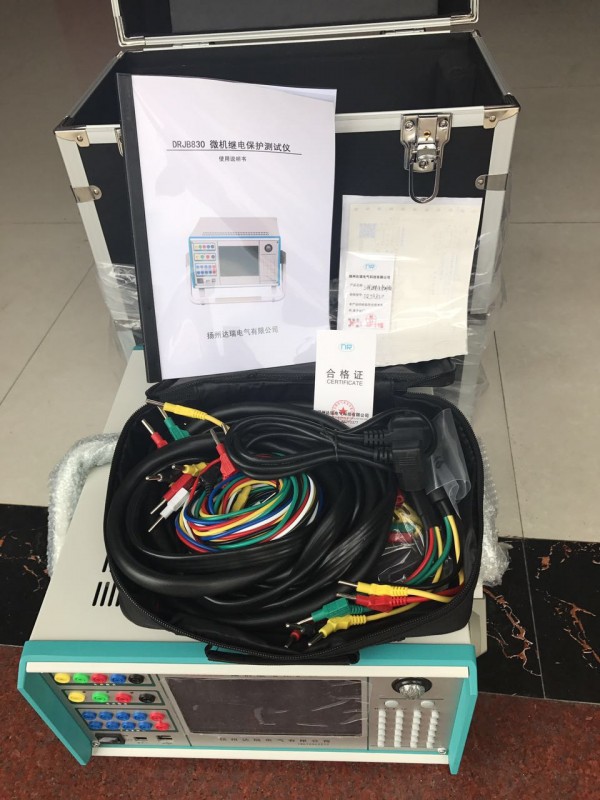
When wide-area relay protection is applied in practice, if centralized protection is implemented in the entire system, the large number of data collection points, massive data, transmission distance and speed caused by the increase in system scale will increase the difficulty of implementing wide-area relay protection, and also increase the difficulty of protection configuration, operation and maintenance, making it difficult to guarantee protection reliability. Therefore, it is also necessary to establish the regional structure of wide-area relay protection based on the actual system, comprehensively consider and reasonably utilize new smart grid technologies, so that wide-area relay protection is more conducive to practical application. The dual-clamp phase volt-ampere meter can conveniently measure the phase between U-U, I-I, and U-I on site, distinguish inductive and capacitive circuits and the phase sequence of three-phase voltage, detect the connection group of transformers, and test secondary circuits and bus differential protection systems.
1. Ensure time and data synchronization
Conventional microcomputer relay protection connects the secondary analog values of each transformer's electrical quantities to the protection device through secondary cables. The device's internal unique system clock drives the analog-to-digital converters of each channel via the control bus, achieving high synchronization accuracy in data acquisition. The protection involved in wide-area protection is not limited to one or two devices, nor to one or two substations. How to maintain time and data synchronization over a large area will be a research focus. The existing time synchronization in substations mainly uses GPS time signals as the external time reference for the master clock, adopting three time synchronization methods: pulse synchronization, serial port synchronization, and coded synchronization, with synchronization accuracy reaching the millisecond level.
In networked substations, distributed electronic transformers and merging units are used for data acquisition. Data is transmitted to electronic devices such as protection via the network. To achieve synchronization of data acquisition and information interaction and coordination among protections, a unified precise clock is needed as the system's time source, and precise time synchronization technology is used to achieve accurate synchronization of the clocks of each data acquisition unit and each protection device.
2. Divide regional structure
The division of regions is conducive to the application research of wide-area relay protection. Analyze the feasibility of wide-area relay protection application in station domains and small areas, and analyze the current configuration of relay protection in the system, the current configuration of wide-area measurement systems, network communication equipment and communication technologies; formulate the regional structure division of wide-area protection within the system, and conduct feasibility studies from aspects such as grid structure redundancy, protection configuration redundancy, and communication redundancy.
Referring to the classic substation structure model, form a hierarchical distributed regional protection configuration scheme within the system. Enable wide-area relay protection to have regional decision-making functions, adapting to the situation of building smart substations with decision-making functions.
Multi-Agent technology [12] can be used for implementation. An Agent is an active entity with knowledge, goals, and capabilities, capable of reasoning and decision-making alone or with minimal human guidance. Some Agents collaborate to complete certain tasks or achieve certain goals, forming a system. Agents have different problem-solving abilities, and they communicate and coordinate according to agreed protocols, making the entire system a high-performance whole, capable of solving problems that a single Agent finds difficult to solve.
3. Adjust backup protection or research and apply new protection
Using the collection of regional information, based on the current configuration of backup protection, comprehensively consider the adaptability of backup protection caused by network topology changes, comprehensively utilize network node switch information and protection action information within the region, research new principles of backup protection, so that protection can quickly respond to phenomena such as main protection refusal to operate and switch refusal to operate, formulate coordination mechanisms among protections within the region, research protection tripping strategies for rapid isolation of faults within the region, and make it feasible for local protection to trip switches within the region.
4. Coordination with traditional protection
During and after the construction of the smart grid, it is inevitable to encounter the problem of protection coordination and cooperation between traditional microcomputer protection and protection in digital substations. The interoperability between different types of protection should be considered, including:
(1) In line differential protection, if one side uses electromagnetic current transformers and the other side uses electronic transformers, when an external fault occurs, the electromagnetic current transformer side is likely to experience single-end saturation. Therefore, the differential protection at both ends of the line should have the function of detecting single-end saturation and preventing maloperation.
(2) The original data synchronization algorithm for line differential protection is based on both sides being analog transformers. There is a data synchronization problem with different transformer types on both sides, requiring research on new protection algorithms.
5. Online adjustment of protection settings
Under complex operating modes and complex grid structures, protection settings may be impossible to set. The solution is to set protection settings according to several typical operating modes, store the settings in different setting zones within the protection device, and build a protection setting expert system library at the station control layer of the regional master station.
When the system's operating mode changes, the local protection can determine the current operating mode based on local parameters (switch node information, electrical quantity information, etc.), send an application to the regional master station for whether to adjust the settings, and the regional master station comprehensively judges whether to adjust and which typical mode settings to adopt based on the system operating mode within the region, and grants adjustment authorization to each protection that needs adjustment, achieving online adjustment.