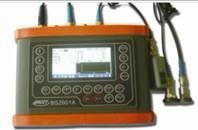
Cable Fault Tester: Path and Fault Locator
It consists of a transmitter, a receiver, an inductive probe, and a potential difference detection frame. The cable fault tester uses the electromagnetic induction method to trace the route and measure the burial depth of optical cables and cables, and uses the potential difference method to locate faults in optical cables and cables. It is suitable for locating the route, burial depth, and poor insulation points to ground of various optical cables and cables with metal conductors (wire pairs, sheaths, shielding layers). It is a dedicated line fault tester for postal and telecommunications systems, as well as for military, railway, mining, oilfield, airport, shipping, and other units.
Features of the Instrument
1. High receiving sensitivity
2. Low static drift Cable Path and Fault Locator
3. Strong anti-interference capability
4. High accuracy and stable operation
5. Dual AC/DC power supply
6. LCD digital display
Main Technical Specifications
1. Maximum distance for route tracing and fault location: 3 km for cables with wire diameter less than 0.5 mm, and up to 20 km for other cables.
2. Fault insulation resistance for accurate pinpointing: 0-50MΩ.
3. Location test accuracy: ≤±10cm
4. Cable depth detection: ≤3m