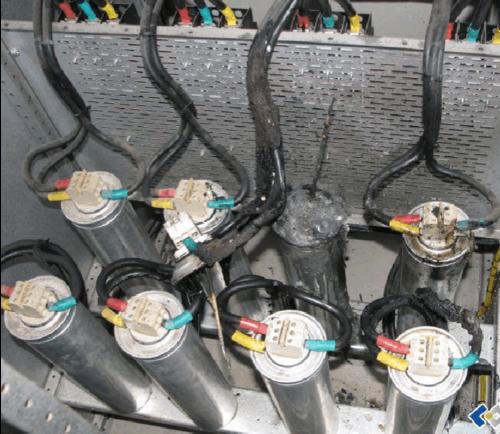

Reactive power compensation, referred to as reactive compensation, plays a role in improving the power factor of the power grid in the electronic power supply system, reducing the loss of the power supply transformer and transmission lines, improving power supply efficiency, and improving the power supply environment. Therefore, reactive power compensation devices occupy an indispensable and very important position in the power supply system. Reasonable selection of compensation devices can maximize the reduction of network losses and improve the quality of the power grid. Conversely, improper selection or use may cause many factors such as voltage fluctuations and increased harmonics in the power supply system.
1. Overvoltage
Overvoltage is extremely harmful to power capacitors. The life of a power capacitor is closely related to the duration, amplitude, and number of overvoltage events. Especially long-term overvoltage can cause the power capacitor to heat up, thereby accelerating insulation aging. Therefore, when the grid voltage exceeds 1.1 times the rated voltage of the power capacitor, it should be taken out of operation. The power frequency withstand voltage test device is suitable for the withstand voltage test of large hydro/thermal generators, using a multi-section reactor in parallel working mode, adjusting the inductance of the adjustable reactor.
2. Overcurrent
When the capacitor current exceeds 1.3 times the rated current or the three-phase unbalanced current exceeds 5%, it should be taken out of operation. Because excessive current will cause the capacitor to burn out.
3. Oil Leakage
Power capacitors are fully sealed devices. If the seal is not tight, air, moisture, and impurities may enter the interior of the power capacitor. When oil leakage occurs in the capacitor, the load should be reduced or the ambient temperature lowered, but it should not be operated for a long time. If serious oil leakage is found in the power capacitor, it should be taken out of service as soon as possible.
4. Bulging Deformation
When a fault occurs inside the capacitor tank during operation, the insulating oil is decomposed by the high temperature of the arc, producing a large amount of gas, which can cause the tank to bulge and deform. In this case, it should be immediately taken out of operation and replaced with a spare.
5. Automatic Tripping of Capacitor Circuit Breaker
After the circuit breaker trips, do not force reclose. At this time, first check the protection action and the relevant primary circuit, such as checking whether the capacitor has exploded, bulged, or sprayed oil. Also check the capacitor's circuit breaker, current transformer, voltage transformer, power cable, etc., to determine the nature of the fault. If there is no such situation, but the circuit breaker trips due to bus voltage fluctuation caused by an external fault, a trial closing is allowed after 15 minutes. Do not attempt trial closing before the cause is identified.
6. Capacitor Out-of-Service Handling
In case of any of the following faults, the capacitor bank should be taken out of service and the duty dispatcher and department leader should be reported.
(1) The capacitor explodes;
(2) The capacitor bushing cracks and has flashover discharge;
(3) The capacitor seriously sprays oil or catches fire;
(4) The capacitor shell has obvious expansion, oil leakage, or three-phase current imbalance exceeds 5%, or there is abnormal sound inside the capacitor or reactor;
(5) The joint is seriously overheated;
(6) The oil temperature of the dense capacitor exceeds 65°C, or the pressure relief valve operates.
In the power supply system, according to the "Technical Measures for Preventing Capacitor Device Accidents", for the high-voltage shunt capacitor part, the capacitance of each capacitor in the capacitor bank should be measured regularly. It is recommended to use the measurement method without disconnecting the connecting wires to avoid the fault of bushing oil leakage caused by the force on the bushing during disassembly and assembly. Therefore, the automatic capacitor and inductance tester can be used to detect capacitors, improving the safety and reliability of the power supply system.