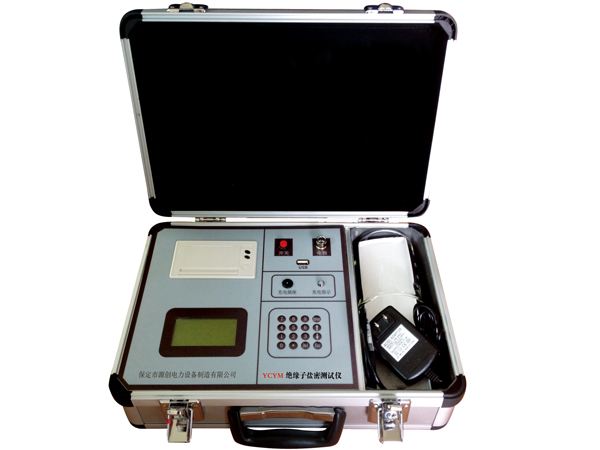
Power systemA special measuring instrument developed for anti-pollution flashover detection, used to measure the equivalent salt deposit density (hereinafter referred to as "salt density") of insulators and the conductivity of solutions.
The instrument complies with the provisions and requirements of GB/T16434-1996 "Environmental Pollution Classification and External Insulation Selection for High-Voltage Overhead Lines and Power Plants, Substations".
The instrument uses a microcontroller as its core, eliminating the need for knobs and measurement segment selection switches found in general instruments, achieving fully automated measurement with LCD display. In addition to measuring salt density, it can also measure solution conductivity, temperature, etc. The whole instrument is characterized by high measurement accuracy, intuitive readings, convenient use, and flexibility. It is widely used in electric power, teaching, scientific research, and other related industries.
Equivalent salt deposit density, abbreviated as ESDD or salt density, refers to the equivalent amount of NaCl salt per unit area on the insulator surface.
Salt density was first adopted as a pollution degree parameter by Japan and later gradually accepted by other countries. It quantitatively measures the conductivity performance of ionizable substances, expressed equivalently by the amount of NaCl salt that produces the same conductivity in a cleaning solution. This amount is called the equivalent NaCl salt amount.