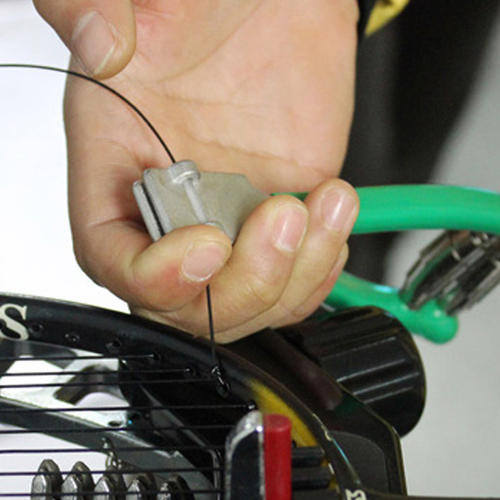

News on February 3rd: When stringing a badminton racket, if you don't use a starting clamp for the first step and directly use a fixed clamp to hold the upper string, compared to using a starting clamp to hold the lower string on the outside of the racket, what is the difference between these two methods?
The starting clamp is designed to resist pulling, and it works by active force application, achieving a single pull. The fixed clamp is designed to prevent rebound, and it works by passive force reception, achieving a double pull (meaning that once the fixed clamp holds the string, the string's rebound will pull the clamp back a bit).
These are two different design philosophies. Although mixing them might not seem to cause major problems on the surface, there is a huge hidden opportunity cost. If you use a fixed clamp for the first step, you are exceeding its "passive" design philosophy and turning it into an "active" grip on the string, resisting the machine head's pull. The opportunity costs are as follows:
1) It is detrimental to the string's outer coating. Because fixed clamps are multi-toothed, the biting force on the clamping surface is distributed across the teeth. Generally, when directly pulling against the machine head, the teeth near the machine head are prone to slight string slippage, especially when the string diameter is too thin, the string coating is too brittle, the tension is too high, or the machine head pulls too quickly. After slippage, the coating can be easily damaged. In contrast, the starting clamp has a single flat surface, so there is no such phenomenon of micro-displacement of teeth on one side causing abrasion to the string.
2) It is detrimental to the lifespan of the clamping surface. Many people do not realize that the clamping surface of a string clamp is actually a consumable item. It either uses quartz sand (diamond sand / emery) or electroplating technology to provide friction for gripping the string. If used for passive force reception and double pull, the wear on the clamping surface can be kept to a minimum. If used for active force application and single pull, the wear rate will be significantly accelerated.
As a rational stringer, saving means success in a sense, but if you also include the starting clamp in the scope of saving, it actually deviates from this original intention and becomes "penny wise, pound foolish." Because to replace a fixed clamp, even a common pair costs nearly a thousand yuan. On the other hand, an entry-level starting clamp costs only 200-300 yuan and works extremely well. I have used one for almost 5 years and it is still almost as good as new. The starting clamp can also save string from large reels. After using several large reels, the cost of the starting clamp is recovered. This does not even account for the improved stringing level, the saved stringing time, and the reduced packaging materials for strings that the starting clamp helps you achieve.
It seems like I have become a salesman for starting clamps, but I want to say that for badminton racket stringing, this should be listed as the most worthwhile basic tool to invest in.