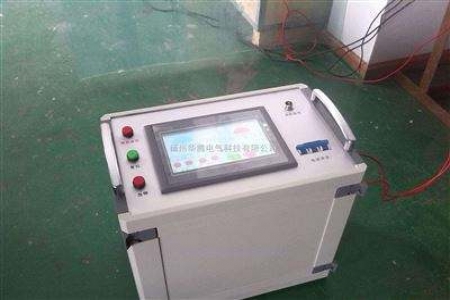

The power frequency withstand voltage test device is the basic test equipment for power stations, power supply and distribution systems, and scientific research units. It is used to conduct insulation strength tests at specified voltages on various electrical products, electrical components, and insulating materials, to assess the insulation level of products, discover insulation defects in the test object, and measure the ability to withstand overvoltage. The power frequency withstand voltage test device is a routine testing equipment in the power system. During the test, attention should be paid to various safety standards to ensure the safety of the test process.
The power frequency withstand voltage test, also called AC withstand voltage test, is a type of insulation withstand voltage test. It is an effective and direct method to identify the insulation strength of electrical equipment and is an important part of power preventive tests. Common power frequency withstand voltage test devices consist of a test transformer and an intelligent control console, which can perform various insulation withstand voltage tests. The AC withstand voltage test is an important means to ensure the safe operation of power equipment. So what precautions should be taken during the operation of the power frequency withstand voltage test?
1) When conducting high-voltage AC/DC tests, at least 2 or more personnel must participate, with clear division of labor and clear methods between each other. There should be a dedicated person to supervise the on-site safety and observe the test status of the test object;
2) The test transformer and control box should have reliable grounding;
3) The test object should be cleaned and absolutely dry to avoid damage to the test object and errors in the test;
4) During the test, the voltage rise speed should not be too fast, and sudden full voltage energization or de-energization is absolutely not allowed;
5) During the voltage rise or withstand voltage test, if any of the following abnormal conditions are found, the voltage should be immediately reduced, the power should be cut off, the test should be stopped, and the cause should be investigated before retesting. ① The voltmeter pointer swings greatly; ② An odor of insulation burning or smoke is found; ③ Abnormal sounds are heard inside the test object.
6) During the test, if the test object is short-circuited or breaks down, the overcurrent relay in the control box will operate. At this time, the voltage regulator should be returned to zero, and the power should be cut off before the test object can be removed.
7) When conducting capacitance tests or DC high-voltage leakage tests, after the test is completed, the voltage regulator should be lowered to zero, the power should be cut off, and then a discharge rod should be used to discharge the high-voltage end of the test object or capacitor to ground to prevent electric shock from the potential stored in the capacitor.
8) In the power frequency withstand voltage test, the current limiting resistor R1 should be selected according to the rated capacity of the test transformer. If the rated output current on the high-voltage side is 100-300MA, it can be 0.5-1Ω/V (test voltage); if the rated output current on the high-voltage side is above 1A, it can be 1Ω/V (test voltage). Commonly, water resistance is used as the current limiting resistor. The length of the tube can be considered as 150KV/m, and the tube and its thickness should have sufficient heat capacity (the water resistance solution is prepared by adding an appropriate amount of copper sulfate to distilled water to prepare various resistance values). The sphere gap and protective resistor: when the voltage exceeds the set value of the sphere gap (generally 110%-120% of the test voltage), the sphere gap discharges, providing protection for the test object. The protective resistor for the sphere gap can be selected as 1Ω/V (test voltage).
9) In the power frequency withstand voltage test, the voltage measured on the low-voltage side (instrument voltage) is not very accurate because the test transformer has leakage reactance. The leakage reactance of the test transformer inevitably causes a voltage drop. In order to accurately measure the voltage applied to the test object, a resistive-capacitive voltage divider is often connected on the high-voltage side to measure the high voltage.
Information compiled by: Yangzhou Tuopu Electrical Technology Co., Ltd., a manufacturer of power frequency withstand voltage test devices