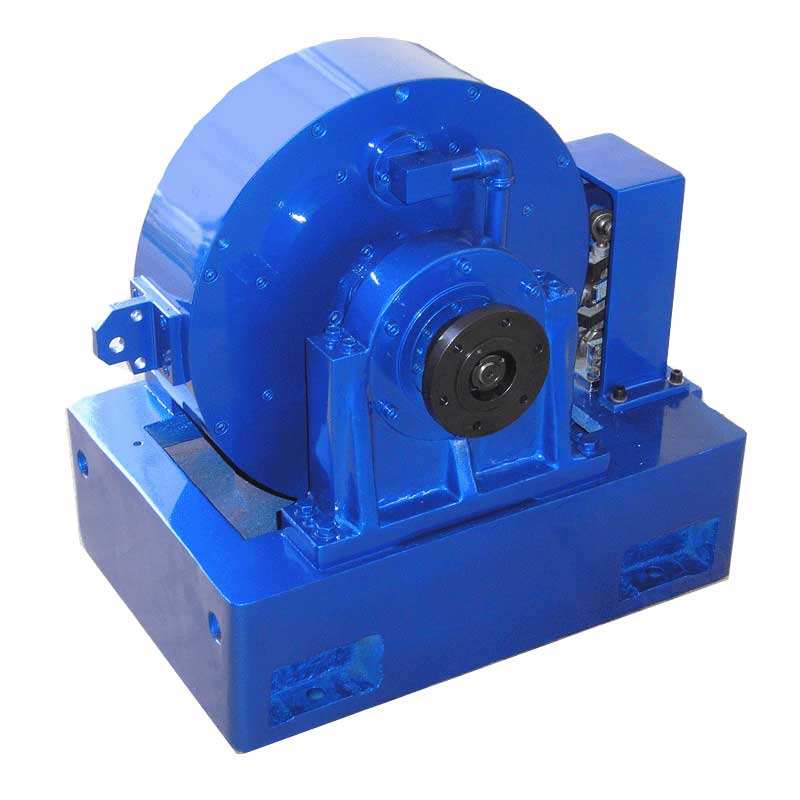
The fundamental principle of the eddy current dynamometer and the hydraulic dynamometer is to convert the mechanical energy generated by the prime mover into heat energy, which is then carried away by water cooling. The energy emitted by the prime mover cannot be recovered, and energy is also consumed during the conversion process.
The hydraulic dynamometer can only load in one direction, and its loading performance deteriorates when the speed is below a certain value; it cannot be used as a reverse towing device. When it is necessary to conduct engine mechanical efficiency tests, a separate towing device must be configured.
The eddy current dynamometer can load in both directions, but its loading performance at low speeds is even worse than that of the hydraulic dynamometer. It cannot be used as a reverse towing device, and when engine mechanical efficiency tests are required, a separate towing device must be configured.
The eddy current dynamometer changes the braking force of the dynamometer through excitation. During loading, it is measured by the torque sensor above. If there is no load, is it that there is no torque display even without towing? If so, it indicates that the sensor is misaligned and needs adjustment. Additionally, if there is torque even without excitation, it is mostly due to increased mechanical loss, and the dynamometer alignment should be adjusted.