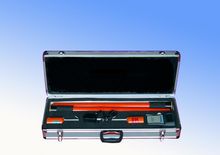
1. Self-test to determine whether the phase instrument is in good condition.
First insert the test wire into the instrument socket, and insert the other end into a 220V power supply. At this time, there should be three reactions as described in Table 4. If there are three reactions, it indicates the instrument is good. If there are no three reactions, it indicates a problem and the instrument cannot be used.
2. Use a multimeter to check whether the high-voltage connection wire is conductive.
3. Notes on testing the meter head:
If the phase verification instrument is detected to be normal using the above methods, formal phase verification can proceed. If it is already known that the phase verification instrument is normal, it can be used directly without testing. If there is no voltage display during testing, it indicates insufficient battery voltage, and the battery should be replaced. Open the instrument housing and replace with a new 9V laminated battery.Note: When the battery voltage is below 6V, there is no audible prompt; as long as the voltage is not lower than 4.5V, it can still display correctly.
4. Connect the high-voltage wires as shown in the figure below:High Voltage Connection Diagram of Digital Display Voice Phase Verification Instrument
5. Pre-test the phase verification device:
Before formal phase verification, the phase verification device can be tested in the same power grid system to check if it is in good condition. One person touches one phase of the conductor with the A rod, while another person touches the B rod to each phase of the conductor in the same grid. As described in Table 4, different phases have three reactions, while the same phase has no three reactions. Then formal phase verification can proceed.
6. Formal operation:
Phase verification operation should be carried out by three people: two operators and one supervisor. It must be operated one by one and recorded one by one. Determine whether the phase is correct according to the "three have, three none" described in Table 4. The phase verification operation must strictly follow the regulations and procedures established by the unit.
7. Maintain safety:
During operation, the human body must not contact the phase verification instrument, high-voltage wires, or grounding wires, and a safe distance must be maintained.
1. The A rod and B rod of the high-voltage phase identifier should be grounded separately. If the ground wire of one rod falls off during work, stop the work and proceed with measurement after reconnecting it.
2. The high-voltage phase identifier should be placed in a dry place and the insulation resistance value should be checked regularly. For the 35KV phase identifier, the contact hook to ground is about 60M. For the 6-10KV phase identifier, it is about 27mm.
3. On-site work is best done by four people, but no less than three, and a second type of work ticket should be filled out.
4. The design of the high-voltage phase identifier has minimized exposed metal parts, but during work, high concentration of mind is still required to prevent line-to-line short circuits and grounding accidents.