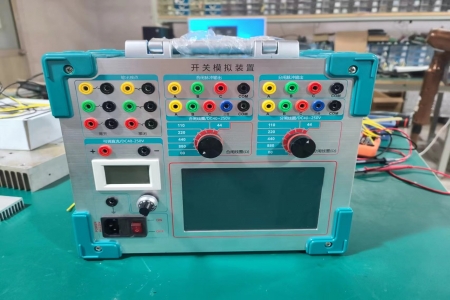
In modern power systems, ensuring the safe and stable operation of the grid is of paramount importance. The high-voltage wireless phase verifier, as an advanced electrical measurement tool, plays an irreplaceable role in power system maintenance. This article will explore the functions and unique advantages of the high-voltage wireless phase verifier in ensuring grid safety.
I. The Role of the High-Voltage Wireless Phase Verifier
The high-voltage wireless phase verifier is primarily used for phase verification in power systems, especially in high-voltage transmission lines and substations. It helps technicians determine the phase relationship between different circuits, which is crucial for grid interconnection operations, fault troubleshooting, and maintenance work. Specifically, it can perform the following key tasks:
Phase Verification: Before performing grid interconnection or loop network operations on power lines, it is essential to ensure phase consistency between lines to avoid short circuits caused by phase errors.
Phase Sequence Detection: In three-phase power supply systems, the correct phase sequence is vital for the normal operation of loads such as motors. The high-voltage wireless phase verifier can detect and confirm the correct sequence of three-phase electricity.
High-Voltage Testing: Before live-line work, it is necessary to verify that the equipment to be operated is indeed de-energized to ensure the safety of operators.
II. Advantages of the High-Voltage Wireless Phase Verifier
1. Enhanced Safety
Traditional wired phase verifiers have many safety hazards during use, such as cable breakage and loose connections, which can lead to electric shock accidents. In contrast, wireless phase verifiers use wireless transmission technology, eliminating the need for physical connections, thereby reducing risks during operation and greatly improving work safety.
2. Convenient Operation
The use of wireless phase verifiers is no longer constrained by physical connections. Operators can complete phase verification tasks from a distance, which is particularly advantageous in spaces with limited access or hard-to-reach locations.
3. Strong Anti-Interference Capability
In complex electromagnetic environments, the high-voltage wireless phase verifier can maintain stable signal transmission and accurate data measurement, thanks to its advanced anti-interference technology. This ensures reliable measurement results even in high-voltage power systems.
4. Multi-functionality
In addition to the basic phase verification function, modern high-voltage wireless phase verifiers often come with various additional features such as voltage testing and phase sequence detection, allowing a single device to meet multiple testing needs and improving work efficiency.
5. Remote Operation and Monitoring
Some advanced models of high-voltage wireless phase verifiers support remote operation, allowing data reading and control via mobile devices, and even enabling remote video communication to confirm phase conditions, further enhancing the device's flexibility and practicality.
III. Conclusion
In summary, the high-voltage wireless phase verifier, with its outstanding performance in safety, convenience, anti-interference capability, and multi-functionality, has become an indispensable tool in power system maintenance. With continuous technological advancements, it is expected that more innovative features will be integrated into such devices in the future to better serve the high-quality development of the power industry.
This article outlines the importance of the high-voltage wireless phase verifier in power system maintenance and emphasizes its advantages over traditional equipment. Through such technological progress, both safety and efficiency in the power industry have been significantly improved.