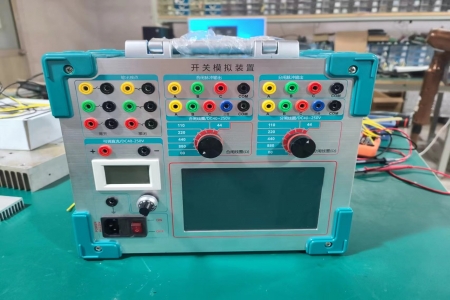
The wireless high-voltage phase detector is a professional instrument used for phase verification and phase sequence verification of high-voltage lines and equipment in power systems. This instrument adopts wireless transmission technology, enabling phase and phase sequence detection without direct contact with high-voltage equipment, ensuring the safety of operators. Below is an outline of an article about the wireless high-voltage phase detector:
Introduction to Wireless High-Voltage Phase Detector
1. Introduction
Background: Briefly describe the importance of phase verification in power systems and its application in power equipment.
Purpose and Significance: Explain the application scenarios of the wireless high-voltage phase detector and its role in power equipment maintenance.
2. Basic Knowledge of Wireless High-Voltage Phase Detector
Definition: Explain the concept and main functions of the wireless high-voltage phase detector.
Working Principle: Introduce the method of comparing two phase signals through wireless transmission.
3. Features of Wireless High-Voltage Phase Detector
Wireless Transmission: Introduce the wireless transmission capability of the phase detector, including penetration through obstacles and straight-line transmission distance.
Voltage Range: Describe the ability of the phase detector to perform phase verification on extremely low-voltage lines, achieving automatic phase verification from 10V to 550kV.
Safety: Emphasize the safety guarantee for operators provided by the wireless detection method.
4. Main Functions and Technical Parameters
Function Introduction: List the main functions of the wireless high-voltage phase detector, such as phase detection, phase sequence measurement, etc.
Technical Parameters: Provide key technical specifications, including measurement range, accuracy, wireless transmission distance, etc.
5. Application Cases
Typical Applications: Provide several examples of actual use of the wireless high-voltage phase detector for phase verification.
Effect Analysis: Analyze test results to demonstrate how to judge the phase status of power lines through test data.
6. Operation Guide
Preparation: Include safety precautions, equipment connection, etc.
Test Steps: Detail how to use the wireless high-voltage phase detector for testing.
Data Analysis: Explain how to interpret test results and identify problem points in power lines.
7. Maintenance and Care
Routine Maintenance: Provide some simple maintenance suggestions to extend the service life of the phase detector.
Troubleshooting: List common problems and their solutions.
8. Safety Precautions
Safety Rules: Emphasize safety precautions to be observed during testing.
Emergency Handling: Explain emergency measures in case of unexpected situations.
9. Development Trends
Technological Innovation: Discuss current development trends in wireless high-voltage phase detector technology, such as intelligence and integration.
Future Outlook: Predict future progress directions and technological breakthroughs in this field.
10. Conclusion
Summary: Summarize the importance and application value of the wireless high-voltage phase detector.
Suggestions: Provide some suggestions for power system engineers and maintenance personnel.
11. References
Literature Citation: List relevant books, papers, or standard documents referenced in writing this article.
Please note that the above content is only an outline framework, not a complete article. If you need more detailed information or specific product materials, please provide more specific details, and I can help you obtain relevant information.