There are various types of faults in power equipment, but most of them are accompanied by heating phenomena. From the perspective of infrared diagnosis, they are usually divided into external faults and internal faults.Transformer winding deformation tester is composed ofa laptop and a microcontroller to form a high-precision measurement system. It is compact, easy to operate, and has relatively complete testing and analysis functions. As is well known, during the operation of a power system, current-carrying conductors will generate resistance losses due to the current effect, and there are numerous connectors, joints, or contacts on the entire power transmission loop. In an ideal situation, the contact resistance of various connectors, joints, or contacts in the transmission loop is lower than that of the connected conductor parts. Then, the heat generated by the connection parts will not be higher than that of the adjacent current-carrying conductors. However, once some connectors, joints, or contacts have poor contact, causing an increase in contact resistance, that part will have more resistance loss and a higher temperature rise, resulting in local overheating. Such faults are usually external faults.
The characteristics of external faults are: high local temperature rise, easy to detect with infrared thermal imagers, and if not handled in time, the situation deteriorates quickly, easily forming accidents and causing losses. External faults account for a large proportion of faults.
The so-called internal faults of high-voltage electrical equipment mainly refer to various faults caused by electrical circuit faults enclosed in solid insulation and inside the equipment shell, as well as insulation medium deterioration. Since such faults occur inside the electrical equipment, the temperature rise on the equipment surface is very small, usually only a few K. Detecting such faults requires high sensitivity of the detection equipment.
The characteristics of internal faults are: small fault proportion, small temperature rise, great harm, and high requirements for infrared detection equipment.
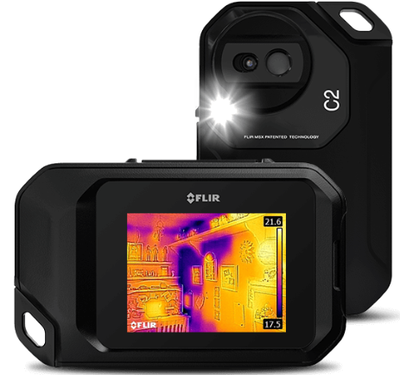
In the power industry, thermal imagers have long been used for equipment safety maintenance, detecting thermal defects in electrical equipment and lines, such as transformers, bushings, circuit breakers, disconnectors, instrument transformers, power capacitors, arresters, power cables, busbars, conductors, combined electrical appliances, insulator strings, low-voltage electrical appliances, and secondary circuits of equipment with current, voltage heating effects or other heating effects. This plays a very critical and effective role in timely detection, handling, and prevention of major accidents.
The so-called thermal defects in electrical equipment usually refer to heating phenomena caused by internal or external reasons, detected through certain means.