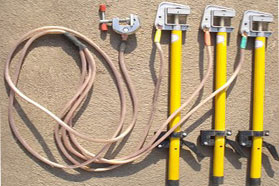
Three-Phase Short-Circuit Grounding Wire
Causes of Short Circuit:
(1) Damage to electrical equipment and components. For example, natural aging of equipment insulation or defects in the equipment itself, leading to breakdown and short circuit during normal operation; as well as equipment defects caused by improper design, installation, or maintenance, which eventually develop into short circuits.
(2) Natural causes. For example, severe weather conditions such as strong winds, low temperatures causing ice coating on conductors, leading to pole collapse and conductor breakage of overhead lines; or due to direct lightning strikes or lightning induction, equipment overvoltage, insulation breakdown, etc.
(3) Human errors. For example, operators violating operating procedures by pulling switches under load, causing phase-to-phase arc short circuits; violating electrical safety work regulations by closing grounding switches with load, causing metallic short circuits; negligence in wiring leading to short circuits; or poor operation and management allowing small animals to enter live equipment, causing short circuit accidents, etc.
Three-Phase Short-Circuit Grounding Wire
Usage Method:
1. Split-phase type: Each set of "grounding wire" consists of three groups, each group is integrated with a conductor-end clamp, short-circuit wire, and grounding-end clamp. Operate group by group during use. According to regulations, first verify no voltage, confirm power outage, then securely fasten the grounding-end clamp to the ground, then select the operating rod according to the voltage level of the de-energized line, and hang the conductor-end clamp on the conductor. After work, first remove the conductor-end clamp, then remove the grounding-end clamp.
2. Combined type: Due to different voltage levels, the combination form and quantity of clamps, and the length of wires vary. Generally, a set of "grounding wire" consists of three conductor-end clamps, short-circuit wires, a grounding wire, and one grounding-end clamp. During use, first verify no voltage according to regulations, confirm power outage, then securely fasten the grounding-end clamp to the ground, then use the corresponding operating rod according to the voltage level to hang the conductor-end clamps on the conductors respectively. (Operating rods are available in fixed and folding types.) When removing, first remove the conductor-end clamps, then remove the grounding-end clamp.
3. After withstanding short-circuit current, the grounding wire should be scrapped.
Hazards of Short Circuit:
1. Huge short-circuit current flows through conductors, generating a large amount of heat in a short time, creating very high temperatures, which can easily cause equipment overheating and damage.
2. Due to the electrodynamic effect of short-circuit current, large electrodynamic forces are generated between conductors. If the electrodynamic force is too large or the equipment structure is not sturdy enough, it may cause mechanical deformation or even damage to electrical equipment, further expanding the accident.
3. During a short circuit, the system voltage suddenly drops, greatly affecting users. For example, asynchronous motors, which are the main power equipment, have electromagnetic torque proportional to the square of the terminal voltage. A significant voltage drop will cause the motor speed to decrease or even stop, causing losses to users; at the same time, voltage reduction can cause lighting loads such as lamps to suddenly dim and some gas discharge lamps to extinguish, affecting normal work, life, and study.
4. When an asymmetrical short circuit occurs in the system, the magnetic effect of the asymmetrical short-circuit current can generate sufficient magnetic flux to induce a large electromotive force in adjacent circuits. This may cause strong interference to nearby communication lines, railway signal systems, and other electronic equipment and automatic control systems.
5. Short circuits can cause power outages, bringing losses to the national economy. Moreover, the closer the short circuit is to the power source, the larger the area affected by the power outage.
The most serious consequence that a short circuit may cause is the loss of synchronization among parallel-operated power plants, destabilizing the system, and ultimately leading to system collapse, resulting in regional or area-wide blackouts.