Dari Electric recommends
I. Portable Salt Density TesterBasis Standards
GB /T 4585-2004 / IEC 60507 :1 991 "Artificial Pollution Tests on High-Voltage Insulators for AC Systems"
GB/T 16434—1996 "Environmental Pollution Classification and External Insulation Selection for High-Voltage Overhead Lines and Power Plants, Substations"
GB 311.1—83 "Insulation Coordination for High-Voltage Transmission and Transformation Equipment"
GB/T 5582—93 "External Insulation Pollution Classes for High-Voltage Power Equipment"
II. Terminology Explanation for Portable Salt Density Tester
Equivalent Salt Deposit Density: refers to the solute density of the contaminant solution equivalent to a sodium chloride solution with the same conductivity, usually expressed in Kg/  .
.
Creepage Distance of Insulator: the total creepage distance L of the insulator divided by the product of the test voltage and ; it is usually expressed in mm/kV.
Pollution Layer: the conductive electrolytic layer on the surface of the insulator composed of salt and inert materials.
Salt Deposit Density (SDD): the amount of salt deposited on a given surface of the insulator (metal parts and cemented materials are not included in this surface) divided by the area of that surface; it is usually expressed in mg/.
III. Introduction
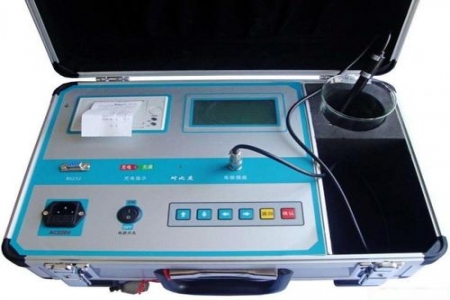
SDMD-II, also known as Direct-Reading Equivalent Salt Density Tester (Salt Density Meter), is specifically designed for testing the equivalent salt deposit density of insulators. The system has built-in calculation formulas for equivalent salt deposit density, providing intuitive readings. It uses a Chinese menu for simple operation. The large-screen LCD display shows all parameters and results at a glance. It is equipped with a large-capacity lithium battery, making it convenient for field testing.
The instrument complies with the provisions and requirements of GB/T 16434—1996 "Environmental Pollution Classification and External Insulation Selection for High-Voltage Overhead Lines and Power Plants, Substations", and is suitable for salt density testing of external insulation equipment in high-voltage overhead lines, power plants, substations, and other locations.
IV. Performance Indicators
Technical Parameters:
● Measurement Range
Electrode constant 1 Conductivity 0.1μs/cm~20ms/cm
Electrode constant 10 Conductivity 2ms/cm~200ms/cm
Temperature Measurement Range Temperature 0℃~100℃
● Measurement Error
Conductivity 1% (Class 1) Temperature ±0.1℃
Equivalent Salt Deposit Density 1% (Class 1)
Note: When testing low-concentration solutions, choose an electrode with a small K value; when testing high-concentration solutions, choose an electrode with a large K value. For detailed selection, refer to the random accessories section.
4.3 Display Output Mode
A. LCD displays measurement results.
B. Measurement data can be directly output via computer.
C. Upload data to computer via data cable for processing.