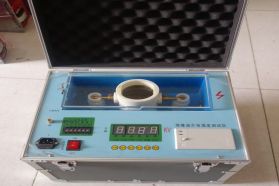
Main features of the dielectric strength tester for insulating oil used in power equipment with Class II maintenance qualification:
Fully automatic measurement: After setting, simply press the test button to complete all work (automatic stirring, automatic settling, automatic voltage increase, automatic voltage decrease, automatic recording of breakdown voltage values, automatic calculation of average breakdown voltage values for each test, and automatic printing of measurement results). An audible alert sounds when the test is complete.
This instrument is equipped with an automatic detection function. Upon power-on, it automatically executes the voltage regulator return-to-zero and enters normal standby mode.
The number of tests, stirring time, and settling time can be adjusted according to user requirements.
This instrument uses fully automatic magnetic stirrer stirring to eliminate unevenness and air bubbles in the oil sample.
It uses a miniature TPU-A panel printer for automatic Chinese printing output.
Precautions for the dielectric strength tester for insulating oil used in power equipment with Class II maintenance qualification:
As this instrument is a dedicated test device for dielectric strength of insulating oil, it should not be used for other purposes. Non-professional maintenance personnel should not open the case arbitrarily.
During use, the safety ground and the chassis housing should be properly grounded.
During the voltage increase process, do not touch the instrument casually to avoid high-voltage hazards.
The dedicated oil cup of this instrument should not be subjected to high-temperature drying treatment arbitrarily.
Basic principles:
This automated test device is composed of advanced technologies such as central processing units and large-scale integrated circuits. The operation process is fully automated, and test data of the oil sample can be printed through the panel-configured micro printer. Compared with ordinary meters and similar instruments, this device has good test stability, high accuracy, and good operability. It has multiple test operation modes during oil testing. Main features:
Fully automatic test mode: Conduct 6 consecutive tests, automatically calculate the average value, and print the 6 test data and the average value through the panel printer.
Single automatic test mode: Automatically complete 1 test and print the single test data.
A reversible AC motor drives the voltage regulator at a uniform speed of 3 kV/s to increase voltage through the step-up transformer. When the oil sample breaks down, the protection system automatically cuts off the voltage increase power supply circuit, and the protection circuit provides an interrupt signal to the system. After the system responds, it executes the oil breakdown test procedure. The main operations include:
The four-digit LED display flashes 8 consecutive times to indicate oil breakdown;
Record test data;
Program-controlled automatic return-to-zero operation. After returning to zero, based on the number of tests, it determines whether to proceed with the next test operation cycle or automatically exit the test state.
Maintenance and care:
1. Repair, care, and adjustment of the instrument should be performed by professional personnel.
2. This instrument can be used indoors and outdoors, but should avoid places with rain, corrosive gases, excessive dust, high temperature, or direct sunlight.
3. The oil cup should be kept clean. During periods of non-use, it should be filled with dry and qualified insulating oil to prevent moisture absorption.
4. After continuous use for one month, the electrodes should be inspected to check whether the electrode gap has changed. Use a magnifying glass to observe whether the electrode surface has darkened. If so, wipe the electrode surface with silk cloth and readjust the electrode gap to meet requirements.
5. Replacing the printer ribbon
The ribbon cartridge is installed before the printer leaves the factory, but after a period of use, it needs to be replaced. The steps are as follows:
1) Open the front cover of the printer.
2) Gently remove the old ribbon cartridge from the print head.
3) Install a new ribbon cartridge. First, gently place the right end of the ribbon cartridge on the gear at the right end of the print head, keep the left end slightly raised without putting it down, press the knob on the ribbon cartridge with a finger and turn it slightly in the direction of the arrow, then put down the left end of the ribbon cartridge.
4) Install the front cover of the printer.
6. Replacing the printer paper roll
The printer is equipped with a paper roll when it leaves the factory. After it is used up, a new paper roll needs to be installed. The general process is as follows:
1) Remove the front cover of the printer.
2) Remove the paper roll shaft from the printer.
3) First, slide the new paper roll onto the paper roll shaft, and press the paper roll shaft into the guide groove of the printer.
4) Cut the front end of the paper into a V shape, put the printer into the printing state, then use your hand to feed the paper head into the paper inlet under the print head. The paper will enter the print head until a certain length protrudes from the front of the print head.
7. Cleaning method for the oil cup
1) Wipe the electrode surface and electrode rod repeatedly with a clean silk cloth.
2) Adjust the electrode gap with a standard gauge.
3) Clean with petroleum ether or ethanol 3-4 times, then blow dry with a hairdryer, and then rinse with the oil sample to be tested 2-3 times.
8. Cleaning method for the stirring paddle
1) Wipe the stirring paddle repeatedly with a clean silk cloth until there are no small particles on the surface. Avoid touching the surface of the stirring paddle with hands.
2) Hold the stirring paddle with tweezers, immerse it in anhydrous ethanol and wash it repeatedly, then blow dry with a hairdryer.
3) Hold the stirring paddle with tweezers, immerse it in the oil sample to be tested and wash it repeatedly.
Technical parameters:
● Working power supply: AC220V±10%, 50Hz±5%
● Measurement range: AC 0~80KV
● Power: 300VA
● Limited current: 5mA
● Measurement accuracy: 1%
● Voltage regulation speed: 2KV/S±10%
● Dimensions: 415×315×315 (mm)
● Weight: 28kg
Technical specifications:
1. Working power supply: AC220V ±10%, 50Hz ±5%
2. Measurement range: AC 0-80KV
3. Limited current: 5mA
4. Measurement accuracy: 1%
5. Voltage regulation speed: 2KV/S±10%
6. Preset settings:
Number of tests: 1-9
Stirring time: 0-1 minute 39 seconds
Settling time: 0-10 minutes 39 seconds
7. Operating conditions:
Ambient temperature: 0℃-35℃
Relative humidity ≤75%
8. Power: 300VA
9. Oil cup gap: 2.5mm (diameter of oil cup feeler gauge)
10. Volume: 415×315×315mm³
11. Weight: 28kg