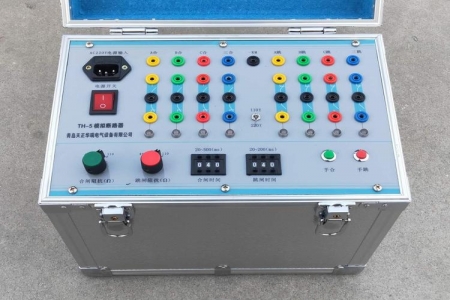
A transformer is a very important electrical device widely used in power systems for voltage transformation. In high-current generators, transformers are used to step up or step down voltage to achieve the required high current output. Below is an article about the application of transformers in high-current generators.
Application of Transformers in High-Current Generators
Overview
Transformers are one of the most fundamental and important components in power systems, capable of changing the voltage level of alternating current to achieve step-up or step-down functions. In high-current generators, transformers play a core role in producing high current output to meet the testing needs of electrical equipment.
Basic Principles of Transformers
The working principle of transformers is based on the law of electromagnetic induction. When alternating current passes through the primary winding, it generates a changing magnetic field in the iron core, which in turn induces an electromotive force in the secondary winding, thereby producing current. The core components of a transformer include:
Iron core: Usually made of stacked silicon steel sheets, used to concentrate magnetic flux and reduce eddy current losses.
Windings: Divided into primary and secondary windings; the primary winding connects to the power source, and the secondary winding outputs voltage.
Cooling system: Used for heat dissipation to ensure the transformer does not overheat during operation.
Transformers in High-Current Generators
In high-current generators, the design focus of transformers is to achieve high current output. To accomplish this, special transformer design strategies are typically adopted, including:
Low impedance design: Reduce the internal impedance of the transformer to allow more current to pass through.
Large-capacity iron core: Use larger core sizes to handle higher magnetic flux.
Multi-winding structure: Multiple secondary windings can be designed as needed to accommodate different testing requirements.
Step-Up and Step-Down
Step-up: In some cases, to generate high current, it is necessary to first step up a lower input voltage. At this time, the primary winding has fewer turns, while the secondary winding has more turns, forming a step-up transformer.
Step-down: If the input voltage is already high enough, but the voltage needs to be reduced to match the load, a step-down transformer is used. In this case, the primary winding has more turns, while the secondary winding has fewer turns.
Application Scenarios
Circuit breaker testing: Use the high current generated by the high-current generator to test the breaking capacity and operating time of circuit breakers.
Contactor testing: Test the pick-up and release characteristics of contactors under different current conditions.
Relay testing: Simulate different current conditions to test the operating thresholds of relays.
Design Considerations
Heat dissipation: High current output generates a large amount of heat, so an efficient cooling system is required.
Safety: Ensure the safety of the transformer and the entire high-current generator device during use.
Durability: Consider long-term durability in design to cope with frequent high-current surges.
Summary
Transformers play a crucial role in high-current generators, producing the required high current output through step-up or step-down. Through careful design and manufacturing, these transformers can meet various testing needs for electrical equipment performance, ensuring the safety and reliability of power systems.
The above is an overview of the application and importance of transformers in high-current generators. If you need more detailed information or an introduction to specific models, please let me know your specific requirements.