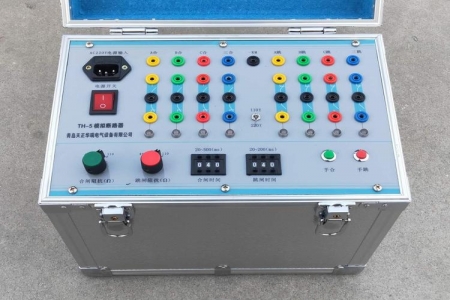

Purpose
No-load loss: Measure the iron loss of the transformer under no-load conditions, including hysteresis loss and eddy current loss.
No-load current: Measure the magnitude of the current flowing into the primary side when the transformer is under no-load conditions.
Test principle
In the no-load test, the rated voltage is applied to the primary side, while the secondary side is in an open-circuit state. At this time, no current flows through the output end of the transformer, but current will flow into the primary side, which is the no-load current. At the same time, the transformer will produce certain losses, mainly the hysteresis loss and eddy current loss caused by the magnetization of the iron core.
Test steps
Preparation:
Disconnect all connections on the secondary side of the transformer to ensure that the secondary side is completely open.
Prepare test instruments, such as digital multimeters, power meters, etc.
Apply voltage:
Connect the primary side to the power supply and gradually increase the voltage until it reaches the rated voltage.
Ensure that the secondary side is completely open.
Record data:
Use instruments to measure and record the voltage, current, and power on the primary side.
Record the ambient temperature, as temperature will affect the performance of the transformer.
Calculate parameters:
No-load loss: The no-load loss is equal to the input power measured at the rated voltage.
No-load current: The no-load current is the primary side current measured at the rated voltage.
Data analysis:
Compare the measurement results with the data on the transformer nameplate or design specifications to evaluate whether the performance of the transformer meets the requirements.
If necessary, temperature correction can be applied to the test results.
Precautions
Safety first: When conducting the no-load test, ensure that all safety measures are in place to avoid electric shock accidents.
Accurate recording: Ensure that all test data is accurate and error-free.
Environmental conditions: Pay attention to recording the environmental conditions during the test, such as temperature, humidity, etc., as these factors may affect the test results.
Example
Suppose we are testing a three-phase transformer with a rated primary voltage of 10kV and a rated current of 100A. Perform the no-load test according to the above steps:
Preparation: Disconnect all connections on the secondary side to ensure that the secondary side is completely open.
Apply voltage: Connect the primary side to the power supply and gradually increase the voltage until it reaches 10kV.
Record data:
Voltage: 10kV
Current: Assume the measured primary side current is 2A
Power: Assume the measured input power is 3kW
Calculate parameters:
No-load loss: 3kW
No-load current: 2A
Through these steps, we can obtain the performance parameters of the transformer under no-load conditions. These data are crucial for evaluating the efficiency and performance of the transformer.