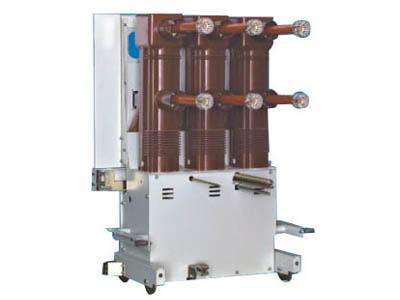

Due to the frequent operation of high-voltage circuit breakers, influenced by mechanical and electrical factors, the phenomenon of refusal to trip often occurs. For circuit breakers already in operation, when a fault occurs on the load side of the circuit breaker, a refusal to trip will inevitably cause a step-up trip, expanding the scope of the accident and power outage. Therefore, it should be eliminated as soon as possible.Intelligent control console hasinsulation impedance testing function, directly reflecting the insulation strength of the tested object
1. Causes of Refusal to Trip
There are usually two reasons for a circuit breaker refusing to trip: one is a mechanical failure in the operating mechanism, and the other is an electrical fault in the operating circuit.
When a circuit breaker refuses to trip, the duty personnel should first determine whether the trip circuit is intact based on the light indication. If the red light is not on, it indicates that the trip circuit is open. At this time, check whether the operating fuse is blown or has poor contact, whether the contacts of the universal changeover switch and the auxiliary contacts of the circuit breaker have poor contact, whether the anti-pump relay coil is broken, whether the operating circuit is disconnected, and whether the bulb and lamp holder are intact.
If the operating power supply is good but the trip core operates weakly, it indicates that the trip coil action voltage is too high, or the operating voltage is too low, the trip core is stuck or detached, or there is a fault in the trip coil itself. If the trip core push rod operates well but the circuit breaker still refuses to trip, it may be due to mechanism jamming or detachment of the transmission linkage pin.
2. Handling
After identifying the cause of the refusal to trip, the duty personnel should remain calm and take different handling measures according to the nature of the fault. For example, during a normal opening operation, if the red signal light does not illuminate, after confirming that the lamp is intact, quickly replace the operating fuse and then perform the opening operation. This should be done by two people: one operates the changeover switch remotely, and the other observes the action of the opening core on site, while maintaining a safe distance. If the core operates weakly, it indicates core jamming; if the opening core operates normally but the circuit breaker cannot be tripped, it indicates mechanical jamming. In this case, use the mechanical opening device on site to interrupt the circuit breaker. For air circuit breakers and SF6 circuit breakers, the air pressure must be normal before mechanical interruption can be performed.
When it is necessary to perform opening in an emergency state, such as when the relay protection device operates or manual remote opening fails, and there is a possibility of damage to the main equipment, the duty personnel should immediately manually open the upstream circuit breaker, then go to the faulty circuit breaker and use the mechanical opening device to interrupt it; if the mechanical opening device cannot open the circuit breaker, quickly disconnect the isolating switches on both sides of the faulty circuit breaker, then restore the power supply from the upstream level, and handle it after identifying the cause; if time permits in an emergency state, the duty personnel should quickly run to the faulty circuit breaker and use the mechanical opening device to open it; if the mechanical opening device cannot open it, immediately change the operation mode, or use the bus tie circuit breaker or the upstream circuit breaker to open it, then use the isolating switch to isolate the faulty circuit breaker and restore the operation mode.
However, it should be noted that because circuit breakers themselves are limited by interrupting capacity, when any of the following faults occur, it is prohibited to open them to avoid explosion accidents.
(1) Oil circuit breaker has no oil or is severely short of oil, or the oil quality is severely carbonized.
(2) When the two-phase insulating tie rods of a low-oil circuit breaker are broken.
(3) Gas circuit breaker pressure is too low and cannot be maintained.
(4) For circuit breakers with hydraulic mechanisms, when the hydraulic system drops to zero.
Once the above phenomena occur, the duty personnel should immediately remove the operating fuse of the circuit breaker, so that the circuit breaker cannot be opened remotely. Even if the circuit breaker is faulty and the protection device operates, it will not cause tripping. At the same time, the duty personnel should hang a warning sign of "No Operation" on the operating handle and the operating mechanism of the circuit breaker, and then handle it according to the following principles.
(1) If a load circuit breaker fault occurs in the plant (station) power supply, transfer the load according to the order of the station manager or dispatcher, then de-energize the bus connected to the faulty circuit breaker, open the circuit breaker, and then restore the upstream circuit breaker operation.
(2) If it is confirmed that the working power supply circuit breaker of a certain plant (station) is faulty, put the standby power supply circuit breaker into operation, cut off the upstream circuit breaker of the working power supply, and then open the faulty circuit breaker.
(3) If a circuit breaker fault occurs, it is necessary to perform a bus transfer operation. When using a bus tie circuit breaker or a bypass circuit breaker to replace it, notify the relay protection specialist to adjust its setting value, and then notify the relevant units for power outage maintenance.
When duty personnel inspect and find the following abnormal phenomena, they should take decisive measures. First, take measures to prevent the circuit breaker from automatically or remotely reclosing, and then use remote operation to quickly open the circuit breaker and de-energize it:
(1) The circuit breaker bushing is cracked.
(2) The circuit breaker is on fire.
(3) A personal accident occurs that requires immediate opening of the circuit breaker.