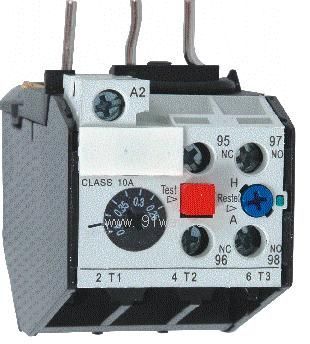

A thermal relay is a protective device used for overload protection of motors or other electrical equipment and circuits.
During actual operation of the motor, such as when driving production machinery, the transformer tester only needs to set the test voltage, current, and step size, and the device will automatically boost the voltage and automatically plot the volt-ampere characteristic test curve, eliminating tedious tasks such as manual voltage adjustment, manual recording, and curve drawing. If the machinery encounters abnormal conditions or circuit anomalies causing the motor to be overloaded, the motor speed decreases, the current in the windings increases, and the temperature of the motor windings rises. If the overload current is not large and the overload duration is short, and the motor windings do not exceed the allowable temperature rise, such overload is permissible. However, if the overload lasts long and the overload current is large, the temperature rise of the motor windings will exceed the allowable value, causing the motor windings to age, shortening the motor's service life, and in severe cases, even burning out the motor windings. Therefore, such overload cannot be withstood by the motor. The thermal relay uses the principle of thermal effect of current to cut off the motor circuit when an overload that the motor cannot withstand occurs, providing overload protection for the motor.
When using a thermal relay for overload protection of a motor, the thermal element is connected in series with the stator windings of the motor, and the normally closed contacts of the thermal relay are connected in series in the control circuit of the electromagnetic coil of the AC contactor. The setting current adjustment knob is adjusted so that the herringbone lever and the push rod are at an appropriate distance. When the motor operates normally, the current through the thermal element is the rated current of the motor. The thermal element heats up, and the bimetallic strip bends after being heated, causing the push rod to just touch the herringbone lever but not push it. The normally closed contacts remain closed, the AC contactor remains energized, and the motor operates normally.
If the motor is overloaded, the current in the windings increases, and the current through the thermal relay element increases, causing the bimetallic strip to heat up more, bending more, and pushing the herringbone lever, which then pushes the normally closed contacts to open, disconnecting the coil circuit of the AC contactor, releasing the contactor, cutting off the motor's power supply, and stopping the motor for protection.
It can be seen that the thermal relay usually disconnects the control circuit of the contactor to disconnect the main circuit.