
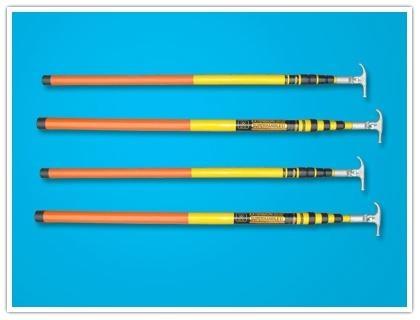
Insulating operating rodis composed of a working part, an insulating part, and a handgrip part, and is used as an insulating tool for short-term operation or measurement on live equipment. During live-line work, the operator holds the end of the rod and uses the front end to contact live parts for operations, such as closing or opening high-voltage disconnecting switches, drop-out fuses, etc. Below, Jinneng Electric provides a detailed analysis of the structure and specifications of the insulating operating rod.
(1) The working part of the insulating operating rod is generally made of metal and is used to directly contact live equipment. According to the needs of the work, the working part can be made in different shapes and installed at the top of the rod. The length of the working part should be as short as possible while meeting the work requirements, generally not exceeding 10 cm, to avoid phase-to-phase short circuits or ground short circuits caused by excessive length during operation.
(2) The insulating part of the insulating operating rod is used for insulation and isolation, generally made of composite materials. Depending on the voltage level, the minimum effective insulation length of the insulating rod should not be less than the values listed in the table below.
Length requirements for insulating operating rods
Voltage level (KV) Minimum effective insulation length (m) End metal joint length (m) Handgrip part length (m, not less than)
10 0.70 ≤0.10 ≥0.60
35 0.90 ≤0.10 ≥0.60
66 1.00 ≤0.10 ≥0.60
110 1.30 ≤0.10 ≥0.70
220 2.10 ≤0.10 ≥0.90
330 3.10 ≤0.10 ≥1.00
500 4.00 ≤0.10 ≥1.00
750 5.00 ≤0.10 ≥1.00
±500 3.50 ≤0.10 ≥1.00
(3) The handgrip part of the insulating operating rod is the part held by the operator. Its material is the same as the insulating part, and it is separated from the insulating part by a guard ring. Depending on the voltage level, the length of the handgrip part should not be less than the values listed in the table above.