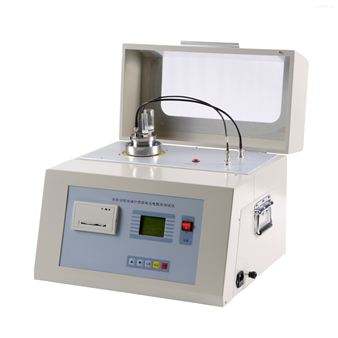
Developed and produced according to national standards, incorporating valuable feedback from customers and market demands, this product utilizes full digital technology internally, with fully intelligent automated measurement, multiple testing modes, and is equipped with a large screen (320×240) touch display, full Chinese menu, with Chinese prompts at every step. Test results can be printed out, and operators can use it proficiently without professional training.
Precautions before using the insulating oil dielectric loss tester
1. Test personnel should have general knowledge of electrical equipment or instruments.
2. Test personnel must strictly comply with safety operating procedures, fully understand high-voltage test circuits, and key points of instrument operation.
3. Non-test personnel must stay away from the high-voltage test area, which must be clearly marked with fences, ropes, or warning signs.
4. Ensure that the tester is reliably grounded.
5. When the fuse is damaged, ensure to replace it with a fuse of the same specification.
6. If the instrument malfunctions, turn off the power switch and wait for one minute before checking.
7. The instrument should avoid severe vibration.
8. Maintenance, care, and adjustment of the instrument should be performed by professionals.
This instrument can only be used on de-energized equipment;
Ensure that the grounding terminals of the instrument and the tested equipment are reliably connected to the grounding grid;
Correctly select the positive or reverse connection method according to the grounding condition of the tested equipment;
Precautions for the insulating oil dielectric loss tester
1. Comply with the safety work regulations for high-voltage tests in your unit.
2. High-voltage tests must be conducted by at least 2 staff members, with one operating and one supervising.
3. After wiring, one person is responsible for checking.
4. After the test, turn off the power switch. It is strictly forbidden to disassemble high-voltage cables while energized!
5. If the instrument shows abnormal conditions, turn off the power switch and wait for about one minute before checking.
6. When calibrating the standard dielectric loss tester in reverse connection, place the standard dielectric loss tester on an insulating object, 60-100cm above the ground, and suspend the high-voltage cable connector in the air away from the ground to avoid the influence of distributed capacitance to ground on the data.
7. If the high-voltage cable is damaged, the low-voltage CX line can be used suspended in the air. The high and low voltage cable connection methods of this product are the same and can be used interchangeably.
8. After measurement, the power switch must be turned off, and wait for about one minute before disconnecting wires.