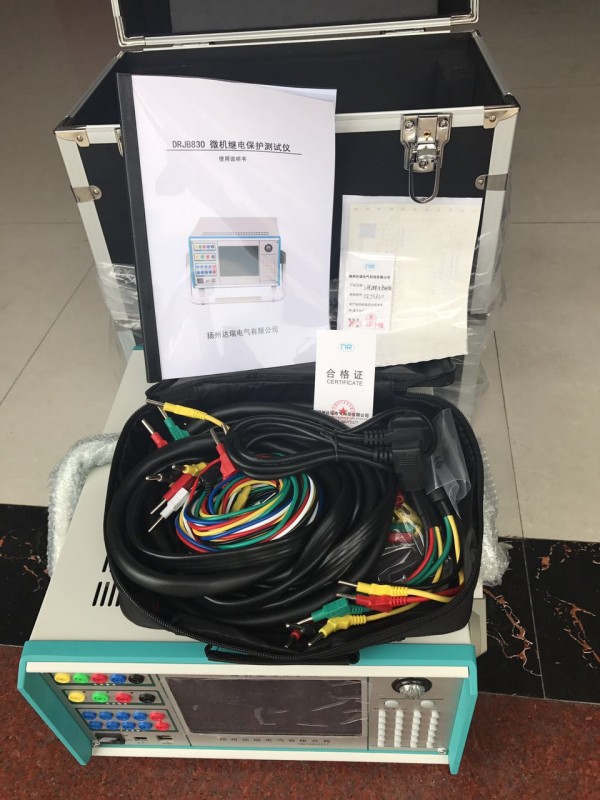

The impedance characteristic test unit is used to automatically test the operating boundary of impedance-type relays (including impedance relays, power direction relays, etc.), i.e., the Z(φ) operating boundary characteristic.
Test Principle
The program mainly uses radial scanning for searching. Radial scanning is generally used to search for closed operating boundaries such as circles and quadrilaterals (e.g., impedance relays).
During the test, the scanning boundary points to be tested are determined by the scanning angle region and step size. Here, the scanning angle is measured with 0° parallel to the R-axis. For example: if the scanning angle region is 0° to 160° with a step size of 40°, the program automatically starts at 0°, ends at 160°, and calculates a scan line every 40° in the counterclockwise direction. The starting point of each scan line is the center impedance Z, and the length is determined by the scanning radius. The intersection point of each scan line with the setting boundary characteristic is the operating boundary point to be searched during the test.
To speed up the search process for each boundary point, the search starting point on each scan line should be as close as possible to the boundary point. For this purpose, the program provides the setting of K% for the search starting point on the scan line, meaning that the boundary point only needs to be searched between K% and 100% of the scanning radius on each scan line. Generally, it should be ensured that K% of the scanning radius is inside the operating zone and 100% is outside the operating zone, i.e., the scan line must completely cover the operating boundary.
If during the calculation process the program finds that the voltage or current at the search starting point or ending point of a certain scan line exceeds the limit, that scan line is automatically ignored.