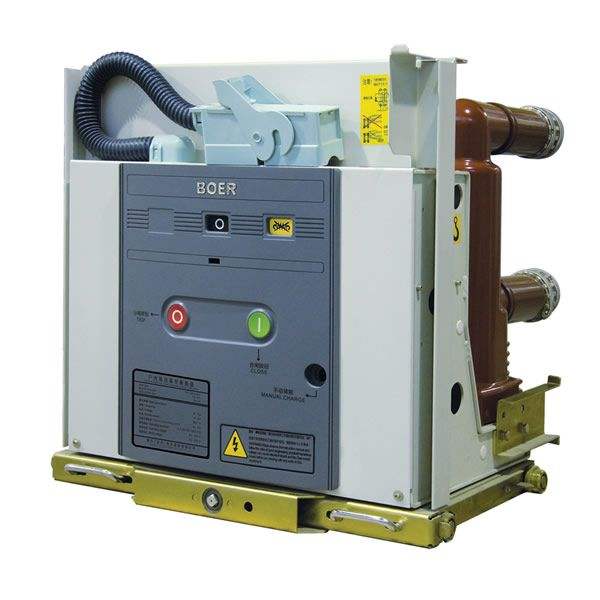
Vacuum circuit breakers are increasingly used in power systems, and research on high-reliability circuit breakers is also deepening. The continuously developing computer technology, intelligent control technology, and permanent magnet technology provide strong technical support for this research. The emergence of permanent magnet operating mechanisms has brought a huge impact on research concepts.
Power system
Requirements for switchgear
High-reliability power systems have a comprehensive, all-round, and systematic requirement for switchgear, with the core being to improve the operational safety and action reliability of equipment. It includes high reliability of breaking performance, high reliability of mechanical operation performance, high reliability of insulation performance, high reliability of environmental tolerance, and high reliability of the secondary control part.
Improving safety performance can be achieved by strengthening the arc extinguishing system capability and insulation level, improving the operating environment or protection level, and redundant protection design of the secondary part. However, improving the action reliability of the mechanism is more difficult to solve. The reliability of the mechanism involves not only mechanics, dynamics, materials science, electrical engineering, and electromagnetism but also factors such as ambient temperature, humidity, and gas corrosion. According to probability theory, the simpler the structure of the mechanism, the higher its reliability. Therefore, simplifying the structure of the mechanism becomes a possible direction. The permanent magnet operating mechanism has many advantages due to its simplified structure.
Strictly speaking, the "permanent magnet operating mechanism" should be called "permanent magnet holding electromagnetic operating mechanism." It reduces the number of overall components or moving parts, reduces volume, and increases reliability. It usually has only one moving part, few fault sources, and its mechanical life can easily reach 30,000 to 100,000 operations. With a simple structure, the number of parts is less than 40% of that of traditional spring operating mechanisms. Through the simplification of the mechanism, maintenance-free operation is achieved. Using electromagnetic performance to realize tripping and locking functions, the mechanical tripping and locking devices with high failure frequency are eliminated structurally. In addition, the closing characteristics (output characteristics) of the permanent magnet mechanism match the reaction force characteristics of the vacuum interrupter almost perfectly, which is also an important reason why the permanent magnet mechanism can quickly occupy the field of vacuum switches.
Permanent magnet mechanism
Working principle of vacuum circuit breaker
Since the permanent magnet mechanism has been greatly simplified compared with the spring mechanism, its control part is relatively complex. To improve the reliability of the control part, the following issues must be solved:
1. Design and optimization of the control circuit (or electrical circuit), mainly determining the control mode and protection functions of the controller, self-test, logic judgment and operation speed, control mode of high-power electronic components (MOSFET or IGBT), input/output types, and other key technical indicators and ways to achieve them.
2. Screening of components, focusing on controlling the quality of key components such as the core control unit, power module, large-capacity energy storage capacitor, power conversion module, output actuator, battery, and position detection element.
3. Overall anti-interference performance of the control circuit (or electrical circuit), including resistance to pulse interference (common mode and differential mode), electrostatic discharge interference, radiated electromagnetic field interference, fast transient interference, conducted electromagnetic field interference, and surge capability.
4. Overall seismic performance of the control circuit (or electrical circuit), including resistance to mechanical vibration, electrical oscillation, lightning protection, and lightning avoidance. The working principle of the permanent magnet mechanism controller is shown in the figure above.
The permanent magnet mechanism vacuum circuit breaker integrates microprocessor technology, modern network communication technology, and new switch manufacturing technology. The main technical parameters include: indoor permanent magnet mechanism vacuum circuit breaker can reach a rated current of 3150 A, short-circuit breaking current of 40 kA, 50 times of full-capacity short-circuit breaking, and mechanical life of 30,000 to 100,000 operations; outdoor permanent magnet mechanism vacuum circuit breaker can reach a rated current of 1250 A, short-circuit breaking current of 25 kA, 50 times of full-capacity short-circuit breaking, and mechanical life of 30,000 to 60,000 operations.
Permanent magnet mechanism
Advantages of vacuum circuit breaker
The permanent magnet mechanism vacuum circuit breaker cooperates well with the vacuum interrupter. It is small in size and light in weight, which is not only convenient for installation but also saves a lot of frame and installation costs for users. The control unit is compact and can be controlled within 100 meters through a wireless remote controller to realize the opening and closing of the switch. It is easy to expand functions, flexible in operation, and easy to realize distribution automation. The permanent magnet mechanism vacuum circuit breaker has all the functions of the spring mechanism vacuum circuit breaker. At the same time, it can also design a new synchronous switch (phase-selection switch), effectively or even thoroughly solving problems that cannot be solved by spring mechanism vacuum circuit breakers.
Solve the problem of operating overvoltage and inrush current generated when switching large-capacity capacitor banks with vacuum circuit breakers. Due to the particularity of capacitor bank loads, switching capacitor banks inevitably generates operating overvoltage and closing inrush current at different phase angles. The direct consequence of operating overvoltage is overvoltage breakdown and restrike; while the closing inrush current can reach more than 4 times the steady-state value, and lasts for a long time, causing great harm to electrical equipment. On the one hand, because the closing bounce of the permanent magnet mechanism vacuum circuit breaker is reduced (it can be easily controlled within 0.1 ms or even shorter), the closing impact force is greatly reduced, which greatly reduces the probability of restrike when switching large-capacity capacitor banks, reduces arc burning of contacts, and effectively solves the restrike problem. On the other hand, it can be completely controlled by the controller to put in the capacitor when the voltage is zero and cut off the capacitor when the current is zero, fundamentally solving the problem of operating overvoltage and inrush current easily generated when switching large-capacity capacitor banks, thereby improving the overall mechanical and electrical life of the vacuum interrupter and the permanent magnet mechanism vacuum circuit breaker.
Solve the problem of closing inrush current generated when closing large-capacity no-load transformers with vacuum circuit breakers. With the continuous increase of transformer capacity in the power grid, the originally inconspicuous problem of closing inrush current when closing no-load transformers becomes very prominent. The excitation current of a transformer during steady-state operation is generally only 2% to 10% of the rated current, but at the moment of power connection (closing), the excitation current can become very large and the frequency is also high, thus forming closing inrush current. In medium and small capacity transformers, because the total amount of such inrush current is not large, the impact on the transformer is also small; but for large-capacity transformers, if the operation happens to be at a phase angle of 0°, the generated inrush current can reach more than 10 times the rated current, causing serious damage to the transformer. Using the advantage of synchronous switches, the closing point can be controlled near 90° or 270°, thereby greatly reducing the closing inrush current, ensuring the safe operation of the transformer and improving its service life.
Solve the problem of operating overvoltage generated when closing no-load lines with vacuum circuit breakers. When closing at different voltage phases, the operating overvoltage generated by no-load lines varies greatly. Among them, it reaches its peak at a phase angle of 90°, and the generated overvoltage can reach more than 2 times the steady-state value during operation, which can cause a decrease in line insulation capability, intensify partial discharge, and even endanger the safety of the entire transmission line. Using the advantage of synchronous switches, the closing point can be controlled near 0° or 180°, thereby greatly reducing the closing operating overvoltage and improving the safe operation level of the line.
Combined with computer control technology, the circuit breaker can be closed or opened at the zero-crossing point of current or voltage. In this case, no arc or only a slight arc is generated. Therefore, there is no need to consider how to extinguish the arc. The outstanding benefits brought by this are: less impact on equipment and the power grid, which is conducive to the safe operation of equipment and the power grid; because there is no or very little arc generation, the breaking performance is greatly improved, or under the same capacity conditions, the volume of switchgear is greatly reduced, reducing material consumption, lowering costs while improving environmental performance; arc extinguishing materials and structures can be greatly reduced, optimizing product design and improving equipment reliability.
After rapid development in recent years, the reliability of permanent magnet technology and permanent magnet mechanism vacuum circuit breakers has been greatly improved, basically meeting the requirements of maintenance-free and intelligent operation. The many advantages it has shown have determined that it is one of the best products to replace traditional spring operating mechanism vacuum circuit breakers. As one of the high-performance key technical equipment required for the research of power supply mode in new socialist countryside and the construction of comprehensive demonstration projects, this product can fully meet the high-reliability requirements of power systems. Permanent magnet technology and permanent magnet mechanisms will also have broad development prospects in high-voltage circuit breakers.