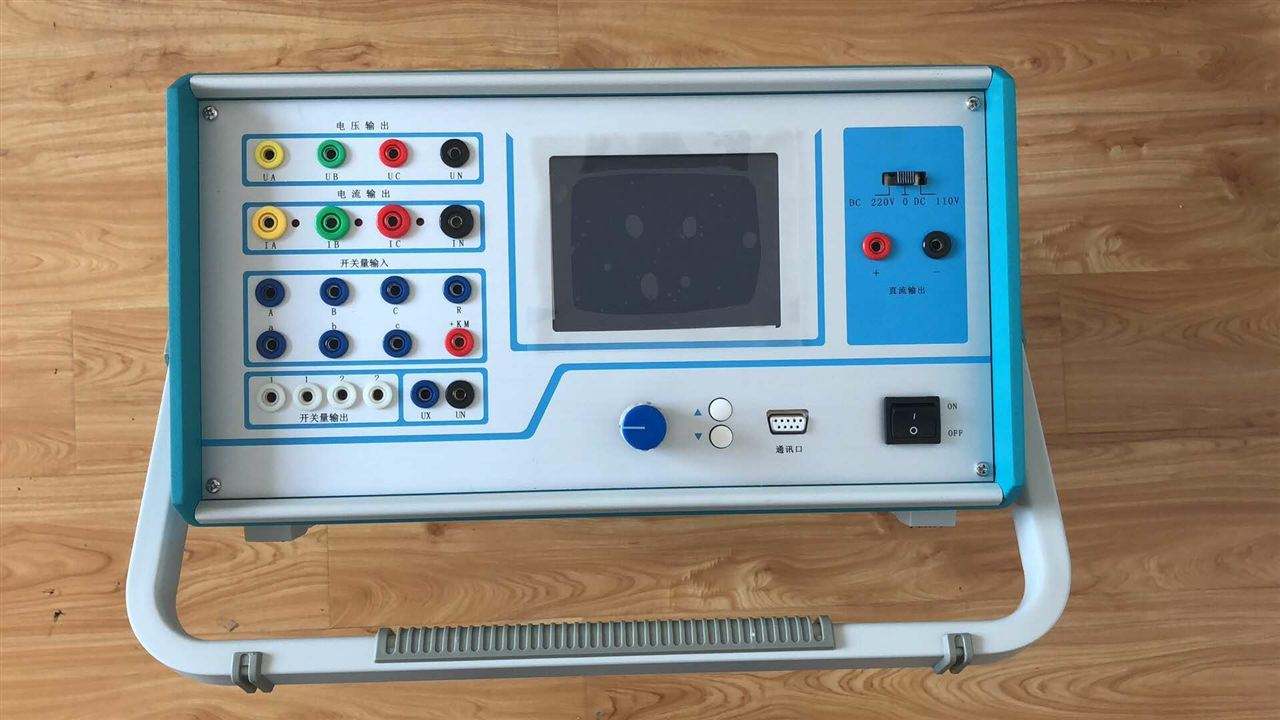
The three-phase/six-phase relay protection tester is developed using modern digital technology, precision electronic devices, microcomputer systems, and new circuits and structures. It can independently complete device testing in professional fields such as microcomputer protection, relay protection, excitation, metering, and fault recording, and is widely used in scientific research, production, and electrical test sites in industries such as electric power, petrochemical, metallurgy, and railway.
Introduction to several protection devices of relay protection:
☆Current protection device
A protection device that utilizes the characteristic of significantly increased current in a fault line is called a current protection device. When the fault current of the line reaches the protection setting value (starting current) in the three-phase/six-phase relay protection tester, the current protection device operates immediately. When the time setting value is reached, it trips the line circuit breaker. Current protection generally includes: instantaneous current protection, overcurrent protection, and directional current protection, etc.
Instantaneous current protection without time delay: Its advantages are simple device, reliable, and fast operation, but it can only protect a part of the line.
Time-delayed instantaneous current protection: Refers to a protection device with a short operating time delay, which can not only protect the entire length of the line but also extend to coordinate with the instantaneous protection of the next-level line.
Overcurrent protection: Refers to a protection device whose starting current is set according to avoiding the maximum load current. It can protect not only the entire length of the line but also the entire length of the next-level line. It can serve as backup protection for the line.
Directional current protection: That is, on the basis of overcurrent protection, a power direction discrimination element is added. When the short-circuit power direction flows from the busbar to the line, the element operates; otherwise, it does not operate, thereby preventing misoperation during reverse faults.
☆Distance protection device:
A protection device that can respond to the distance (impedance) between the fault point and the protection installation location. It has good directionality and is widely used on ring network lines with higher voltage. Currently, three-stage distance protection is widely adopted, namely distance stages I, II, and III.
Distance stage I: Instantaneous operation. Protects 80%-85% of the entire length of the line.
Distance stage II: Protects the entire length of the line and stage I of the next line.
Distance stage III: Protects the entire length of the line and the entire length of the next line, serving as backup protection for stages I and II.
☆Zero-sequence current protection device:
In a power grid with a directly grounded neutral point, when a single-phase ground fault occurs on a line, a large zero-sequence current will appear. A protection device that uses zero-sequence current to constitute ground short-circuit protection is called a zero-sequence current protection device. It often adopts a three-stage scheme.
Zero-sequence stage I: Instantaneous zero-sequence current protection, protecting 70%-80% of the entire length of the line.
Zero-sequence stage II: Time-delayed zero-sequence current protection, protecting the entire length of the line and a part of the next line.
Zero-sequence stage III: Zero-sequence overcurrent protection, protecting the entire length of the line and serving as backup protection for the next line.
☆High-frequency protection device:
It is a protection device that converts the current phase (or power direction) at both ends of the line into high-frequency signals, transmits these signals to the opposite end through a high-frequency channel, and compares the current phase or power direction at both ends.
High-frequency protection does not respond to faults outside the protected line, and its setting does not need to coordinate with the next line. It is a protection without time delay that quickly clears any fault on the protected line. According to its working principle, high-frequency protection can be divided into two categories: high-frequency blocking protection and high-frequency phase difference protection.