
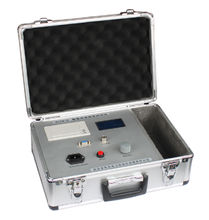
The salt density tester is based on a microcontroller, employing fine segmentation, intelligent prediction, and other measurement methods; digital filtering overcomes interference, Newton's iteration method solves circuit nonlinearity and accumulated errors at each step, and floating-point arithmetic ensures calculation accuracy and measurement range.
2.1. Measurement Range
Salt Density: 0.0000mg/cm2 ~ 9.9999mg/cm2 (based on X-4.5 insulator) Temperature: 0℃ ~ 50℃ Conductivity: 0 ~ 100000μs/cm
2.2. Measurement Accuracy
Salt Density: Resolution 0.0001, full-scale accuracy better than ±2%
Temperature: Resolution 0.1, accuracy better than ±0.5℃
Conductivity: Resolution is 1/1000 of the electrode range used, full-scale accuracy ≤±2%
This electrode consists of two platinum black plated platinum sheets (platinum black electrode), with an electrode constant in the range of 0.80 to 1.20. The electrode head of the conductivity electrode is easily damaged. When measuring, be careful not to collide with the container to avoid damage. When measuring solutions with very low conductivity, use containers made of neutral glass, quartz, or plastic with low solubility. To prevent the platinum black electrode from becoming inert during use, it must be immersed in distilled water before and after use. Once the platinum black electrode is found to be inert, rinse it with distilled water or reconfigure the platinum black electrode.
1. GB/T 1634-1996 "Environmental Pollution Classification of High-Voltage Overhead Lines and Power Plants, Substations"